Valve End Connections: Threaded, Socket Weld, Butt Weld
A practical comparison of threaded, socket weld, butt weld, flanged, and hub end connections — sealing, strength, leak paths, thermal effects on trim, and how to choose by service.
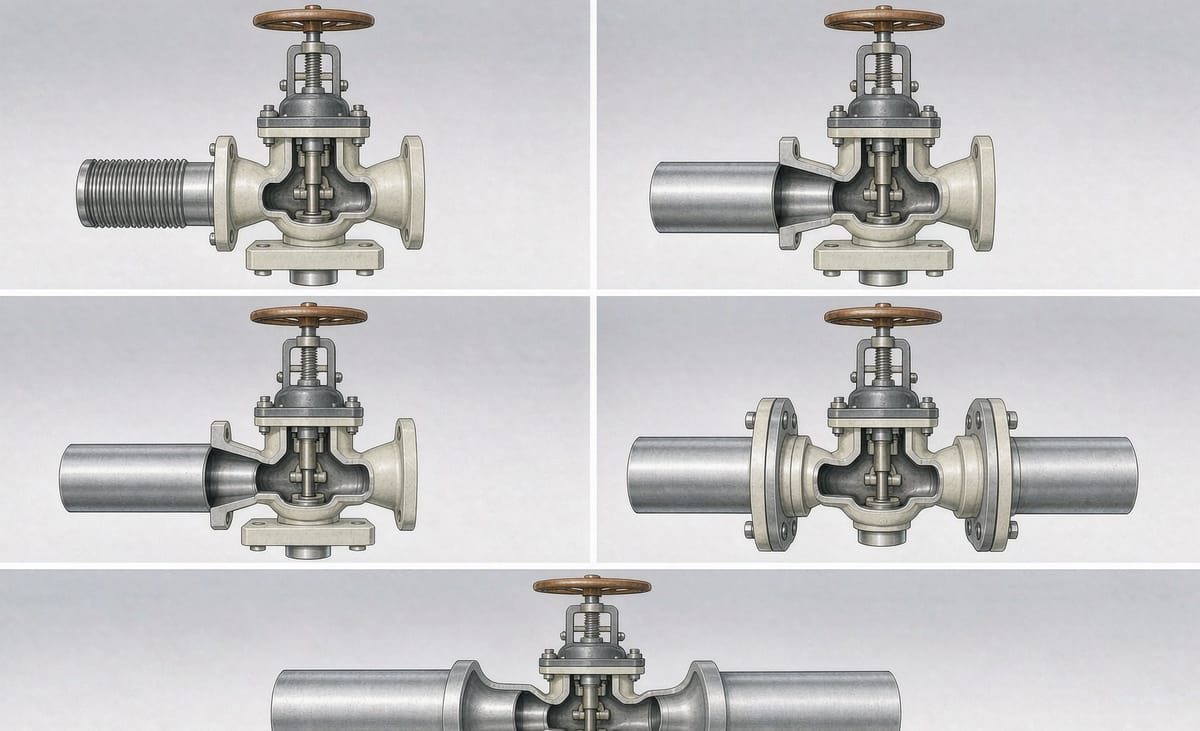
Valve End Connections: Threaded, Socket Weld, Butt Weld, Flanged, and Hub
The valve body gets the attention, but the end connection decides half of what happens in service: whether the joint leaks, whether the valve can be removed for repair, whether welding distorts the seat, and how much the installation costs. End-connection choice is often made by piping-spec convention rather than by analysis — which is workable, because those conventions encode decades of experience, but it still fails in both directions: welded connections specified where maintenance access matters, flanges bolted into places only a weld belonged.
Here is how the main options differ and where each belongs.
Threaded Ends: NPT and BSP
Threaded connections seal by interference between tapered threads — NPT in North America, BSPT and BSPP in much of the rest of the world — usually assisted by thread sealant or tape. They remain the default for small-bore utility and instrument piping.
The strengths are real:
- Fast installation with no welding, no hot work permits, and no special equipment.
- Valves can be unscrewed and replaced quickly — valuable on skids, air lines, and water systems.
- Low installed cost in small sizes.
The limitations follow from the geometry. A tapered thread is a spiral leak path that depends on sealant; it is not a metal-to-metal pressure boundary the way a weld or a clamped gasket is. Threaded joints loosen under cyclic thermal loading and vibration, and the cutting action of assembly can gall stainless and alloy threads. Practical upper bounds sit in the small-bore range and moderate pressure classes; beyond that, risk grows faster than savings. For flammable or toxic media, most piping codes restrict or prohibit threaded joints in larger sizes or higher classes, and designers should treat those restrictions as a floor, not a target.
Socket Weld Ends
Socket weld ends provide a recess into which the pipe inserts before a single external fillet weld is applied. The joint is stronger than threading, needs no sealant, and accommodates some misalignment. Assembly requires only basic fit-up: set the pipe back against the internal shoulder, back off slightly to allow for weld shrinkage, and run the fillet.
Socket weld is the workhorse of small-bore, high-pressure piping — chemical injection lines, sample systems, hydraulic and steam auxiliary circuits. The internal crevice between pipe and socket is its known weakness: in services prone to crevice corrosion, or where a crack-sensitive medium collects in the gap, that pocket becomes a failure initiation site. Fatigue performance is adequate but inferior to a full-penetration butt weld, and radiographic inspection of a fillet weld is limited compared with a butt weld.
Butt Weld Ends
Butt weld ends are beveled for a full-penetration weld that makes the valve and the pipe a continuous pressure envelope. This is the strongest and most leak-tight connection available, and it is the standard for main process lines in power, refining, and petrochemical service at higher classes.
The advantages:
- No gaskets, no crevices, no leak path beyond the weld itself — the best joint for fugitive-emission-sensitive and high-temperature service.
- Full radiographic inspectability of the weld.
- Lighter than a flanged assembly at the same rating; no bolts to preload and monitor.
The costs are operational, and they are often underestimated. Welding a valve in place exposes the internals to serious heat: soft seats and elastomers must be removed before welding, and even all-metal trim can be distorted or stress-relieved out of tolerance by a careless sequence. Field repair of an all-welded installation requires cutting the valve out and welding a replacement in — a hot-work job with line flushing, permits, and downtime. And the weld shrinkage pulls on the valve body, which on thin-bodied or precision-trim valves demands a documented welding procedure, backing rings where appropriate, and temperature limits at the body. Any specification for butt-weld valves should state seat and seal material temperature limits during welding, and the manufacturer's welding instructions should be mandatory reading.
Flanged Ends
Flanged connections remain the most widely specified end for good reasons: the valve bolts between pipe flanges and can be removed without cutting, the joint is inspected at the gasket, and bolting can be retorqued in service. Flanged valves dominate water treatment, general process service, and anywhere maintenance access without hot work is a priority.
But flanges bring their own engineering:
- The gasket is a managed leak path — it requires correct bolt preload, gasket selection for the medium and temperature, and periodic checks. Nearly every joint made can be unmade, and bolted joints loosen with thermal cycling.
- A flanged valve assembly is heavier and bulkier than a weld-end equivalent: four extra flanges per valve, studs, nuts, and the space to swing a wrench.
- Gasket blow-out at extreme temperatures and fire exposure must be addressed through gasket choice and, in critical service, fire-safe testing of the whole valve assembly.
Flange facing, rating, and drilling must match the mating flanges — an apparently trivial coordination item that still generates site rework when inch-metric or class differences slip through.
Hub Ends and Clamp Connections
Hub (clamp) ends pair a machined hub with a clamp and a seal ring, squeezing the seal between hub faces. They combine weld-metal integrity with rapid field assembly: the hub is welded to the pipe during fabrication, and the valve is then clamped in place without hot work at the valve itself. Clamp connections are standard in high-pressure hydraulic and test systems, and variants appear in offshore and subsea service where make-up speed and repeated disconnection justify the machined hubs. The seal is compact and metal-to-metal capable; the drawbacks are hub cost, the need for precise hub-face condition, and a joint that concentrates load in ways less forgiving of poor alignment than a flange.
Weld-hub style ends on smaller valves follow the same logic: weld once at fabrication, assemble and disassemble mechanically forever after.
Matching Connection to Service
Industry habits are a useful shorthand because they encode failure experience:
- Power generation: butt weld on main steam and feedwater; flanged on ancillary systems; threaded only on lowest-consequence utilities.
- Refining and petrochemical: butt weld in higher classes and hydrocarbon mains; flanged at equipment boundaries and wherever removal is planned; socket weld on small-bore with attention to crevice corrosion.
- Water and wastewater: flanged almost universally in larger sizes, with mechanical couplings and threaded small-bore auxiliaries.
A Selection Checklist
Before locking an end connection into the valve datasheet, run through these points:
- Will the valve ever need removal, and can hot work be permitted there?
- What is the maximum temperature at the joint, and does the gasket or sealant survive it?
- Does the medium attack crevices or require full radiography of welds?
- Do vibration, thermal cycling, or pressure pulsation argue against threads and for a welded or clamped joint?
- What are the seat and seal temperature limits during welding, and who owns the welding procedure?
- Has the extra weight and bolt space of flanges been carried into piping stress and structural design?
An experienced manufacturer that produces the full valve range in-house — ball valves, control valves, gate valves, globe valves, check valves, strainers, knife gate valves, plug valves and butterfly valves — can support this review with end-connection options, welding guidance, and gasket and bolting data for each series. Send your Valve Schedule or the key parameters for each position to the manufacturer's applications team for a per-line proposal.