Valve Coating Systems: FBE, Liquid Epoxy, and PTFE
Comparing FBE, dual FBE, liquid epoxy, and PTFE valve coatings — surface preparation, thickness and holiday testing, cathodic protection, and repair.
Valve Coating Systems: FBE, Liquid Epoxy, and PTFE Coatings Compared
Coatings are specified loosely more often than almost any other valve feature. A line item reading "epoxy coated" can mean three different systems with different preparation requirements, temperature limits, and failure behavior — and the difference shows up years later as rust bleed at a flange or disbondment under an insulation jacket. This article sorts out what the main industrial coating systems actually do, where each one belongs, and what the specification must say for the coating to survive its environment.
First, Separate the Jobs: Exterior Versus Interior
Most coating confusion starts with a question nobody asked at the specification stage: is the coating protecting the outside of the valve or the inside?
- Exterior coatings fight atmospheric corrosion — humidity, salt, industrial gases, buried-soil electrochemistry, and temperature under insulation. The media inside never touches them.
- Interior coatings serve two different purposes depending on service. In water systems they reduce friction and prevent tuberculation; in chemical service they isolate the carbon-steel body from the media; in slurry service they resist abrasion. But an interior coating is never a substitute for proper materials selection at the sealing surfaces.
The two sides have different preparation, application, and inspection requirements, and they are often different systems on the same valve. A buried ball valve, for example, typically carries FBE or liquid epoxy on the exterior and nothing on the interior if the media is clean natural gas, or a different lining if it is water.
Fusion-Bonded Epoxy (FBE)
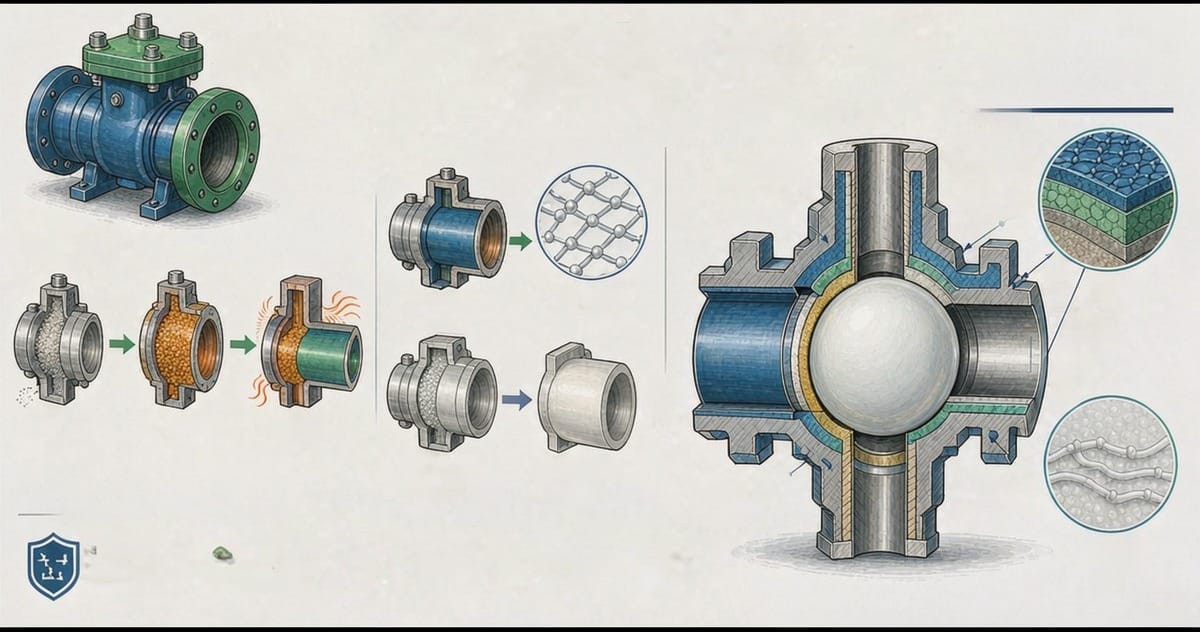
FBE is an epoxy powder applied electrostatically to a heated casting. The powder melts, flows, and chemically crosslinks in a single step with no solvent, producing a dense, well-bonded film. Its credibility comes from the pipeline industry, where FBE has been the standard pipe coating for decades, and the same chemistry and the same application discipline carry over to buried and submerged valves.
- Strengths. Excellent adhesion to properly prepared steel, good cathodic disbondment resistance, compatible with cathodic protection systems, and effective over a service temperature range that covers most buried and submerged applications.
- Single-layer FBE. The workhorse. A film in the range of a few hundred micrometers handles buried service where soil stresses are moderate.
- Dual-layer (abrasion-resistant) FBE. Adds a tougher outer powder layer over the corrosion layer, for directional drilling, rocky backfill, and river crossings where mechanical damage is the dominant threat. If a valve will be pulled through a bore or buried in stony ground, dual-layer is the defensible choice.
- Watch-outs. FBE is thin by design, so it forgives nothing in surface preparation. It is also less forgiving of long outdoor storage before installation — ultraviolet exposure chalks the surface, which is cosmetic but often triggers site rejections.
Liquid Epoxy Coatings
Liquid epoxies are two-component systems applied by spray or brush and cured chemically. They come in an enormous range of formulations, which is both their strength and the specification problem: "liquid epoxy" without a defined system means nothing.
- Exterior use. High-build liquid epoxies are common on valves because castings have complex geometries — flange faces, bolt pockets, body cavities — that powder application covers unevenly. A high-build system can achieve film thicknesses several times greater than single-layer FBE, tolerating surface irregularities that would leave a thin film with voids.
- Interior use. Potable-water-approved liquid epoxies are the standard lining for valves in water transmission. In chemical service, novolac and other high-crosslink-density epoxies extend resistance to acids and solvents, within limits that must be checked against the actual media and temperature.
- Watch-outs. Two-component mixing errors and ambient conditions during cure are the main quality risks in the shop. Film thickness also varies more than with powder, which is why inspection is critical.
PTFE and Fluoropolymer Coatings
Fluoropolymer coatings occupy a different niche. Their value is chemical inertness and non-stick behavior, not corrosion barrier performance in the structural sense.
- Chemical service. PTFE-based coatings resist an extraordinarily broad range of media, which makes them the choice for valves handling aggressive chemicals where a full fluoropolymer lining is specified but the component geometry suits a coating.
- Anti-fouling and low friction. On internals where product buildup is the problem — sticky media, crystallizing brines — a fluoropolymer surface keeps parts clean and reduces operating torque.
- Watch-outs. These coatings are applied thin, and their barrier properties depend absolutely on a continuous, pore-free film. They are harder to touch up than epoxies, and repair of a damaged area is often a full recoat rather than a spot patch.
Surface Preparation Decides Everything
Whichever system is chosen, the coating will perform no better than the surface under it. Blasting to near-white metal, with a defined angular surface profile within the coating manufacturer's specified roughness range, is the non-negotiable baseline. The practical points that get skipped under schedule pressure:
- Blasting after machining weld repairs and after any heat treatment, not before.
- Blasting and coating within the specified time window, before flash rust forms — shorter in humid climates.
- Masking machined seating and sealing surfaces so the coating never touches surfaces that must remain bare metal.
- Verifying surface profile with replica tape rather than trusting the operator's eye.
Thickness, Cure, and Holiday Testing
Inspection is where coating specifications earn their keep. A specification that only names the coating system, without inspection requirements, invites the cheapest possible interpretation of it.
- Dry film thickness. Measured with calibrated gauges against the specified minimum and maximum. Thin spots are the leak paths; excessively thick epoxy can crack.
- Cure verification. Solvent rub or hardness checks confirm the film actually cured, particularly for two-component liquids applied in cold weather.
- Holiday (pinhole) testing. A low-voltage wet sponge test for thinner films, and high-voltage spark testing for thicker ones, sweeps the surface for pores and voids that visual inspection misses. For buried and immersed service this test is essential, because a single pinhole becomes a concentrated corrosion cell — especially under cathodic protection, where current concentrates at the flaw.
- Adhesion testing where the specification or the service justifies it, typically on sample coupons or qualified procedure trials rather than on every production valve.
Compatibility with Cathodic Protection
For buried valves, the coating and the cathodic protection system are one package. A coating with poor cathodic disbondment resistance will peel back around every coating defect under the influence of the protective current, enlarging flaws rather than merely exposing them. This is precisely why FBE dominates buried service: its disbondment performance is well characterized. When specifying, require the coating system's cathodic disbondment test data rather than assuming compatibility.
Repairing Coating Damage
Damage in transport and handling is common, and the repair procedure matters as much as the original application. Spot repairs to liquid epoxies are straightforward: abrade, clean, rebuild to thickness, re-test. FBE repair uses compatible two-part liquid epoxy repair compounds, which is acceptable for localized damage but not for large areas, which should trigger recoating. Damaged fluoropolymer usually means recoating the component. The purchase document should state the accepted repair method and the re-inspection required after repair, so the site crew is not improvising.
Matching the System to the Environment
The short version of selection logic:
- Buried or submerged: FBE, dual-layer FBE for mechanical abuse, with holiday testing and cathodic compatibility documented.
- Atmospheric industrial or marine splash zones: high-build liquid epoxy systems, often multi-coat, selected for the local corrosivity category.
- Potable water interiors: certified liquid epoxy linings with the applicable drinking-water approval.
- Aggressive chemicals and anti-fouling duties: PTFE and other fluoropolymer coatings, with continuity verified by holiday test.
A competent manufacturer that produces the full valve range in-house — ball valves, control valves, gate valves, globe valves, check valves, strainers, knife gate valves, plug valves and butterfly valves — can support this review with coating datasheets, application procedures, and test reports for each system. Send your Valve Schedule or the key service parameters for each position to the manufacturer's applications team for a per-line coating recommendation.