Stainless Steel Families for Valves: 304, 316, 321, and
304, 316, 321, and 347 stainless steels for valves compared: cast equivalents CF8, CF8M and CF8C, sensitization, stabilized grades, molybdenum and pitting, low-temperature toughness, and selection guidance.
Stainless Steel Families for Valves: 304, 316, 321, and 347 Compared
Stainless steel valve bodies are usually specified by a single familiar shorthand — "304" or "316" — while the nameplate on the actual casting reads CF8 or CF8M. That shorthand hides real differences that matter in welded, reheated, chloride-bearing, and cryogenic service. This article walks through the austenitic family as it applies to valves: what the cast designations correspond to, why sensitization and stabilization matter, what molybdenum actually buys, and where the standard grades should be left alone.
The Composition Ladder and Its Cast Equivalents
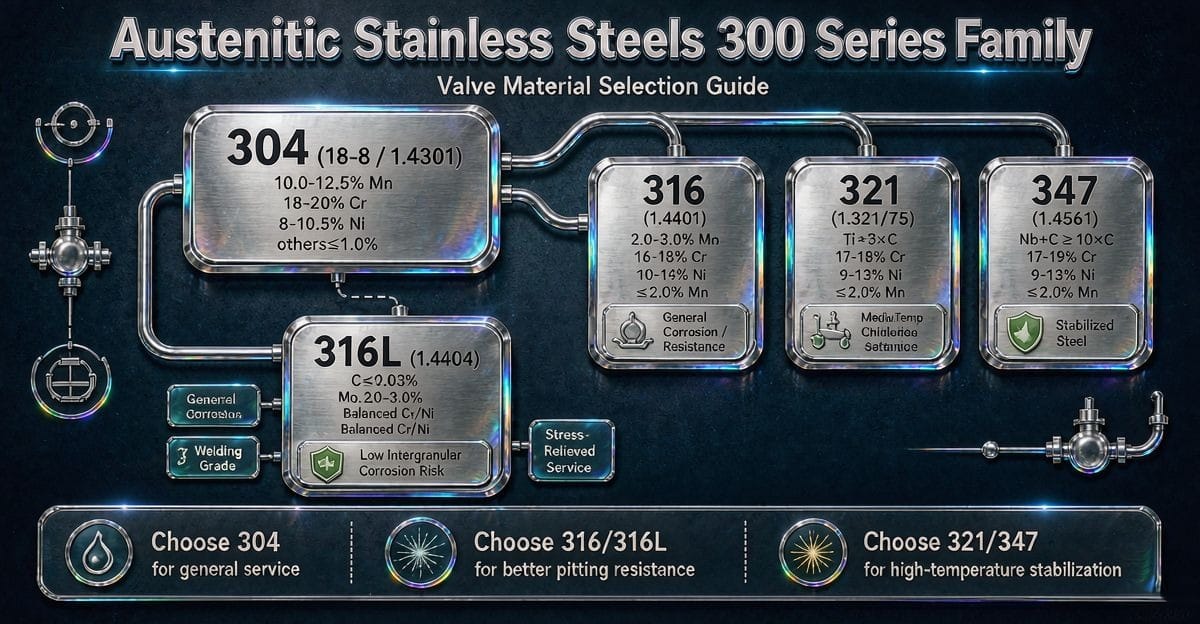
The wrought and cast designations pair up as follows:
- 304 — the baseline 18Cr-8Ni austenitic grade; cast as CF8.
- 304L — the low-carbon version, typically below 0.03% carbon; cast as CF3.
- 316 — the baseline grade plus roughly 2–3% molybdenum; cast as CF8M.
- 316L — low-carbon 316; cast as CF3M.
- 321 — the 304 chemistry stabilized with titanium; cast as CF8C.
- 347 — the 304 chemistry stabilized with niobium plus tantalum; no widely used cast counterpart, so 347 valves are more often forged or fabricated from wrought material.
All of these are austenitic: their crystal structure is stabilized by nickel, they are non-magnetic in the solution-annealed condition (though castings show weak magnetism due to ferrite content controlled for hot-tearing resistance — a point that matters later), and they cannot be hardened by heat treatment, only by cold work.
Sensitization: Why Carbon Content Dominates the Discussion
Austenitic stainless steels owe their corrosion resistance to chromium. When a welded or thermally cut component dwells in the range of roughly 450–850 °C, chromium carbides precipitate at grain boundaries and deplete the adjacent metal of chromium. The result is intergranular corrosion — the grain boundaries dissolve preferentially in the right media, and a weld that looked perfect fails by disintegration along a line. This is sensitization, and it is the single most important metallurgical concept in this family.
Two remedies exist, and the grade list embodies both:
- Lower the carbon so there is not enough of it to form harmful carbide networks — the L grades (304L, 316L, CF3, CF3M).
- Bind the residual carbon with a stronger carbide former than chromium — titanium in 321, niobium in 347. These are the stabilized grades.
321 and 347: The Stabilized Grades and Their Niche
A fair question: if L grades solve sensitization, why do stabilized grades exist at all? The answer is that L grades solve sensitization by starving the steel of carbon — which also removes the carbon that contributes to high-temperature strength. The stabilized grades keep normal carbon levels and deliberately add titanium or niobium to form their own stable carbides instead.
That gives 321 and 347 a distinct territory:
- Service with repeated thermal cycles or post-weld heat treatment, where an L grade would lose creep strength.
- Elevated-temperature service above roughly 425 °C, where prolonged exposure would otherwise allow chromium carbide precipitation over time even without welding.
- Equipment that will be stress-relieved or reheated after fabrication — stabilized grades tolerate this; L grades can re-sensitize at the carbide precipitation temperature during slow cooling from PWHT.
Between the two, 347 has historically been preferred in power plant and high-temperature hydrocarbon service because niobium carbides are more thermally stable than titanium carbides and resist coarsening. 321 is common in chemical and thermal cycling duties and is often the more economical plate and fitting material. One caution applies to 347: during multipass welding, niobium-rich constituents can cause hot cracking in the weld metal, so filler selection and technique deserve attention.
Molybdenum: What 316 Actually Buys Over 304
Molybdenum in 316 substantially improves resistance to pitting and crevice corrosion in chloride-bearing environments. The rough industry comparison uses the pitting resistance equivalent number, or PREN, in which molybdenum contributes roughly three times as much as chromium per percent. The practical translation:
- 304 is comfortable in potable water, mild chemicals, and food or pharmaceutical contact where chlorides are low.
- 316 becomes the sensible choice once chlorides, brackish water, or coastal atmospheres enter the picture — the reason it is called marine grade, somewhat generously.
- Neither grade is a chloride-immunity guarantee. 316 still pits in warm seawater or under deposits in stagnant chloride service; where those conditions are real, super austenitic or duplex grades belong in the conversation instead.
There is also a cost angle: 316 carries a molybdenum premium. Specifying 316 across the board "to be safe" is a defensible default in many plants, but in genuinely aggressive chloride service it can create false confidence while a properly selected duplex or super austenitic grade would have been the correct answer.
Urea-Grade and Low-Carbon Trade-offs
Urea and carbamate service deserves its own note. Standard CF8M castings may contain ferrite — deliberately, to resist hot tearing during casting — but in urea service ferrite is selectively attacked and corrodes away, leaving a roughened surface and contaminating the product. Urea-grade castings therefore restrict ferrite content and control chemistry tightly, and the same logic drives selection of low-ferrite or fully austenitic materials in other carbamate-containing circuits. The lesson generalizes: the standard ferrite control that helps castability can be exactly wrong in specific chemical services, and the line specification should call it out explicitly rather than relying on the generic grade designation.
Low-Temperature Behavior
Austenitic stainless steels hold toughness far into the cryogenic range, which is why they dominate liquefied gas service. That said, not all members are equal:
- Standard 304 and 316 retain good impact toughness well below the temperatures of many cryogenic duties, but their strength rises and design codes apply temperature-dependent allowances.
- The L grades are the default for welded cryogenic vessels and valve bodies because weldability without sensitization matters even at cold temperatures, and because some specifications limit nitrogen and carbon for low-temperature impact performance.
- For the deepest cryogenic service, specifications often require liquid-nitrogen impact testing on the actual heat rather than relying on grade data alone.
Mix-Ups, PMI, and the Magnetic Trap
Material verification in the valve yard is a real problem, not a hypothetical one. Two failure modes recur:
- 316 supplied or installed where 304 was ordered, or the reverse, because both are austenitic and indistinguishable to the eye. Molybdenum is the only chemistry difference that matters, and it cannot be seen.
- Stabilized or L grades mixed with standard grades on projects that weld everything, so a standard-carbon 304 body welded into an L-grade piping system re-sensitizes at the weld.
Positive material identification, or PMI, using portable X-ray fluorescence or optical emission spectrometry resolves most of this, and should be a purchase-order requirement with a defined sampling plan per heat and per lot — not an ad-hoc check on whatever the inspector happens to touch. A note on magnetism: cast CF8 and CF8M bodies are mildly magnetic because of controlled ferrite, so a magnet is not a legitimate rejection tool for castings, though a strongly magnetic body on a wrought 316 order is worth investigating.
A Selection Sequence
For a valve schedule, a compact decision path:
- Mild duty, no chlorides of consequence, no sustained temperature above the sensitization band: 304/CF8.
- Chlorides present, or a conservative general chemical default: 316/CF8M, accepting the premium as insurance.
- Welded bodies or piping that will see post-weld heat treatment or heavy thermal cycling: 321 or 347, or CF8C where casting is viable.
- Cryogenic or deeply refrigerated duty: 304L/316L family, with impact testing on the heat where the specification demands it.
- Urea, carbamate, or other ferrite-sensitive chemistry: urea-grade restricted-ferrite material, stated explicitly on the purchase order.
- Warm seawater or severe chloride crevice service: look past this family entirely to duplex or super austenitic grades.
Choosing with Manufacturer Support
Grade selection interacts with more than chemistry — seat and trim materials, gasket compatibility, welding procedure qualifications, and PMI scope all follow from the body grade decision. An experienced manufacturer that produces the full valve range in-house — ball valves, control valves, gate valves, globe valves, check valves, strainers, knife gate valves, plug valves and butterfly valves — can review the valve schedule line by line, confirm grade-to-service fit including stabilized and urea-grade variants, and provide heat certificates and PMI records with each delivery. Send the per-line design conditions to the manufacturer's applications team for a material proposal with supporting documentation.