Soft Seat Materials Compared: PTFE, PEEK, PCTFE, and Nylon
A practical comparison of soft seat materials for valves — PTFE, PEEK, PCTFE, nylon and filled grades — covering temperature and pressure limits, cold flow, chemical compatibility, and failure modes.
Soft Seat Materials Compared: PTFE, PEEK, PCTFE, and Nylon
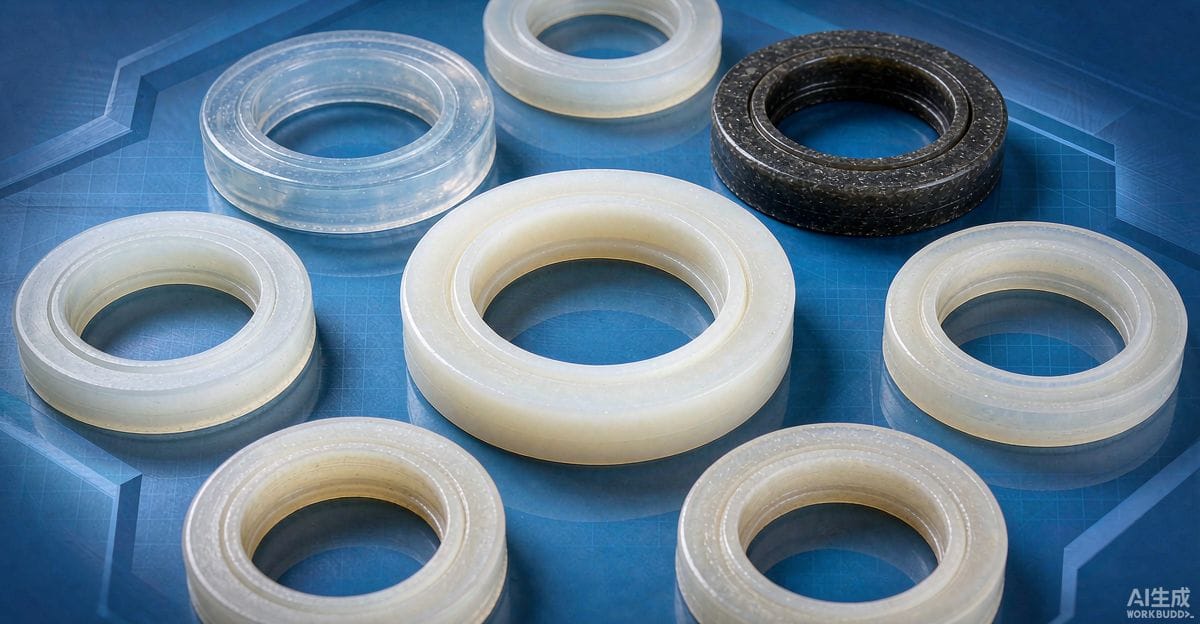
Soft seats are how modern valves achieve tight shutoff. A metal seat, however well machined, conforms imperfectly; a polymer seat deforms slightly under load, fills the microscopic valleys, and closes the leak path. That same willingness to deform is also the soft seat's weakness — it extrudes, it creeps, it has temperature limits that metal laughs at. Choosing among PTFE, PEEK, PCTFE, and nylon is therefore a matter of mapping each material's deformability and limits onto the actual service: temperature, pressure, media, and cycling.
PTFE: The Chemical Workhorse with a Cold-Flow Problem
PTFE is the default soft seat material for good reasons. Its chemical resistance is nearly universal — it is essentially indifferent to almost everything the process industries handle — and its low friction gives seats a smooth, low-torque operating feel. Its useful range reaches down to cryogenic temperatures and up to a moderate elevated-temperature ceiling that depends on the pressure and the design.
Its weakness is cold flow, the polymers' version of creep: under sustained compressive stress, PTFE slowly deforms and does not recover. A seat loaded continuously for months takes a permanent set, and when the valve re-closes after thermal or pressure movement, the deformed seat no longer contacts fully — and leakage appears. Cold flow is aggravated by temperature and by sustained seat loading, which is exactly the duty of a valve that sits closed for a long time.
The standard countermeasure is reinforcement. Glass-filled and carbon-filled PTFE grades resist cold flow substantially better than virgin material, at a modest cost in friction and chemical range — fillers open the material's pores to attack by some aggressive media, so filled grades must still be checked against the process fluid. Reinforcement narrows the gap but does not repeal the physics: at elevated temperature and high seat stress, PTFE still creeps, and the designer must manage the stress through seat design — limited interference, spring-loaded or pressure-energized seat elements — rather than by material choice alone.
PEEK: Strength at Temperature and Pressure
PEEK occupies the opposite corner of the map. Where PTFE is chemically heroic but mechanically soft, PEEK is mechanically strong — its strength and stiffness hold up at temperatures far beyond PTFE's comfort zone, and its resistance to extrusion under high differential pressure is dramatically better. In severe service ball valves and high-pressure trims, PEEK seats handle combinations of temperature and pressure where PTFE would simply flow out of the seat pocket.
The trade-offs: PEEK is more expensive, and its chemical compatibility, while broad, is narrower than PTFE's — it has known vulnerabilities to some strong alkaline environments and certain aggressive media at elevated temperature, so compatibility must be verified against the actual fluid and temperature, not assumed. Filled PEEK grades — glass or carbon fiber — push the mechanical envelope further for extreme pressure duty, again with the compatibility caveat sharpened.
In practice, a useful mental model is that PEEK buys back the temperature and pressure territory PTFE surrenders, at the price of money and a compatibility check.
PCTFE: The Low-Temperature Specialist
PCTFE exists because PTFE, for all its cryogenic reputation, is not ideal in real cryogenic equipment: at very low temperatures PTFE becomes stiff and its already-poor creep behavior combines with thermal contraction to open leak paths. PCTFE keeps useful mechanical properties and low gas permeability deep into cryogenic territory, which is why it appears in liquid nitrogen, oxygen, and LNG applications where seat tightness at extremely low temperature is the whole point.
Its upper temperature ceiling is low compared with the others, and it is the most expensive of the four in typical seat sizes. It is a specialist: chosen when the service temperature goes low enough, ignored otherwise.
Nylon and Its Relatives: Wear and Impact
Nylon (polyamide) and high-performance variants such as the long-chain polyethylenes and aramid-reinforced compounds branded for valve duty sit in a different niche. Their strengths are abrasion resistance and impact toughness — they tolerate slurries, grit, and rough cycling better than the fluoropolymers, and they resist deformation under repeated seat slamming. This makes them common in abrasive powder service, mining, and slurry valve seats where the seat sees mechanical abuse rather than chemical attack.
Their limits are moisture absorption — nylon absorbs water, which changes dimensions and degrades properties — and a chemical resistance list far shorter than PTFE's. They are temperature-limited compared with PEEK. Within their envelope, they outlast fluoropolymer seats in abrasive service by a wide margin.
Mapping the Boundaries
Putting the four in one frame, the selection logic runs along three axes:
- Temperature: PCTFE rules the deep cryogenic end; PTFE spans cryogenic to moderate heat; PEEK extends far above PTFE's ceiling; nylon stops earliest on the hot side.
- Pressure and extrusion resistance: PEEK dominates; reinforced PTFE is adequate in moderate duty; virgin PTFE extrudes first; nylon and its variants do well mechanically in their temperature range.
- Chemical compatibility: PTFE is nearly universal; PEEK is broad with exceptions; PCTFE is good but must be verified; nylon is the most restricted.
Two design realities cut across the material choice. First, the numbers on any datasheet are uniaxial and idealized — actual seat performance depends on the seat geometry, the interference fit, the differential pressure across the seat, and whether the design load-relieves the seat at temperature. A modest material in a well-designed seat pocket outperforms a heroic material in a naive one. Second, the seat rarely works alone: most robust designs combine a soft seat insert with a metal seat back, so the metal carries the pressure loading and prevents extrusion while the polymer face provides the sealing conformity. This hybrid arrangement is standard in severe ball valve trims precisely because it lets a softer, more conformable polymer do the sealing without being asked to do the structural work.
Failure Modes to Watch
The recurring soft seat failures map cleanly onto the materials:
- Extrusion under differential pressure — the polymer is pushed into the clearance between seat and body or ball. Managed by anti-extrusion geometry, metal seat backs, and filled grades.
- Cold flow and set — permanent deformation under sustained load, producing leakage after long idle periods. Managed by reinforcement, spring-loaded seats, and occasional seat re-engagement in service.
- Compression set and embedding — hard particles pressed into the seat face, creating leak paths, common in dirty service where nylon and hard-faced designs do better.
- Thermal aging and embrittlement — long exposure near the material's temperature ceiling degrades the polymer; the symptom is a seat that was fine for years and then suddenly chips or loses resilience.
- Chemical attack — swelling, softening, or embrittlement from a medium the material was never checked against; almost always traceable to an unchecked compatibility assumption rather than an exotic fluid.
A Selection Path That Holds Up
A workable selection routine runs: establish the true temperature extremes including upset and ambient cases, establish the maximum differential pressure the seat must hold including the closed-valve case, verify chemical compatibility of the specific grade at those conditions, decide on cycling and abrasiveness, and only then pick material and seat construction together. Skipping the upset-temperature check is the most common route to a seat that works in normal service and fails during the first hot excursion.
Because the seat material and the seat design are inseparable, the choice is best made with the valve maker's data rather than a generic polymer datasheet. A manufacturer's applications team can map your actual temperature, pressure, and media profile against their seat options — virgin and filled PTFE, PEEK, PCTFE, and reinforced polyamide grades — and recommend the seat construction, including metal-backed arrangements, that fits each line. An experienced manufacturer that produces the full valve range in-house — ball valves, control valves, gate valves, globe valves, check valves, strainers, knife gate valves, plug valves and butterfly valves — can support this review with material qualification documents and seat test data. Send your Valve Schedule or the key parameters for each soft-seated position to the manufacturer's applications team for a per-line proposal.