Repair or Replace: The Valve Decision Framework
How to decide between valve repair and replacement — damage assessment, body integrity, remaining life, downtime windows, cost comparison and long-term economics.
Repair or Replace: The Valve Decision Framework
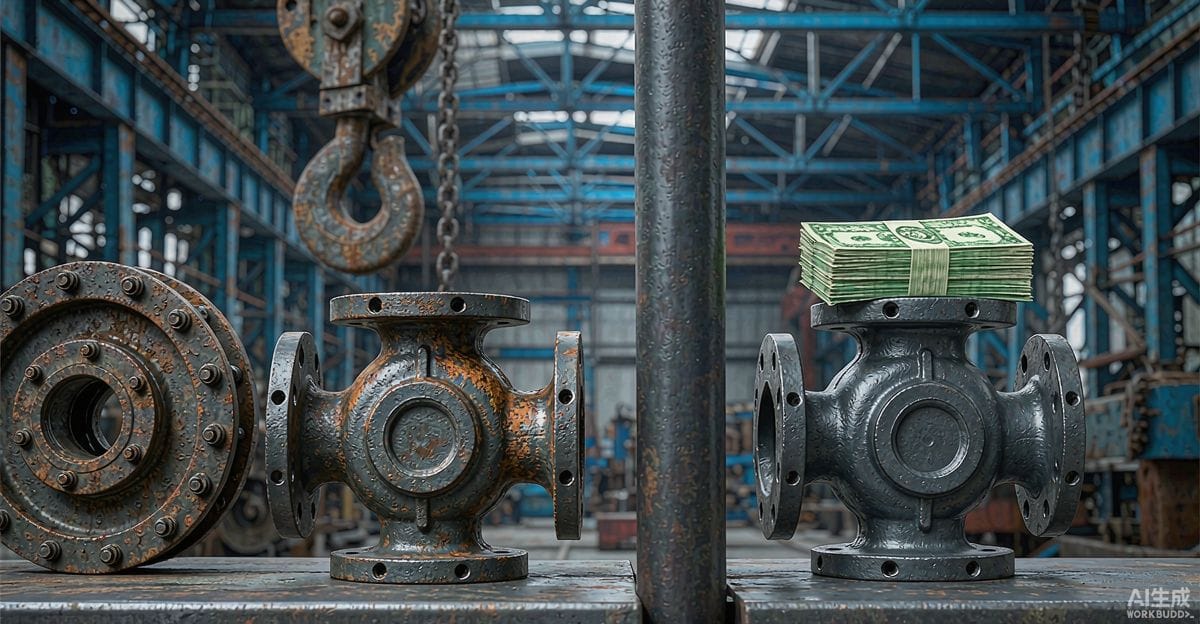
Every maintenance planner eventually faces the same fork: a large valve has failed or degraded, and the choice is between a repair — lapping, new trim, weld restoration — or a replacement unit. The wrong call costs money in both directions. Repairing a valve that should be scrapped buys a second outage on the same line; replacing a valve that a competent reconditioning could have restored wastes budget and, worse, can take a year of lead time the schedule does not have. The decision deserves a framework, applied valve by valve, rather than a habit.
The Factors That Actually Drive the Decision
Strip the question down and a handful of factors dominate every repair-versus-replace call.
- Extent of damage. A scored seat and a worn stem are repair items. A cracked body, a wall thinned well below minimum thickness by erosion, or a seat area eroded past the reach of machining are not.
- Body integrity. The body is the long-lead, high-value component. If the body is sound and traceable, repair has a natural advantage. If the body is compromised, the argument for repair largely collapses because the expensive part is the one that failed.
- Remaining life expectation. A valve near the end of its design life in a corrosive service may come back from repair technically sound but economically short-lived. Repair buys cycles, not decades, when degradation mechanisms are still active.
- Outage window. If the line is down now and the repair route takes weeks, the calendar decides. The honest comparison is repair duration against replacement duration including delivery, not against an imaginary instant fix.
- New valve delivery time. For large forged bodies, exotic alloys, or specially tested valves, delivery can dominate the decision. Where a certified stock replacement or a rental valve is available, replacement becomes far more attractive than it would be on paper.
- Total cost comparison. Repair cost should include disassembly, transport, machining, welding, heat treatment, retesting, and reinstallation — plus the risk-weighted cost of the repair not holding. Replacement cost should include removal, civil and piping modifications if the new valve differs, and commissioning.
What Is Genuinely Repairable
A capable valve shop can restore a surprising range of damage, and knowing the boundary saves both money and arguments.
- Seat and disc refinishing. Light to moderate seat damage is handled by lapping in place or by machining and grinding in a shop. Moderate damage can be restored by weld overlay of the seating surface followed by machining to dimension.
- Stem recovery. A worn or scored stem can be ground and chrome-plated within tolerance, or simply replaced with a new machined stem.
- Packing and sealing systems. Gland areas, soft seats, gasket faces, and seal welds are routine reconditioning scope.
- Limited weld repair of the body. Local defects such as porosity, small cracks with a defined root, or minor erosion at a non-pressure-critical location can be excavated and rewelded by qualified procedure, followed by post-weld heat treatment where the material requires it.
What Is Not Worth Repairing
Some conditions end the discussion, whatever the budget says.
- Body cracks in pressure-retaining walls, especially in cast bodies where the crack path is hard to map and the repair weld shrinks as it cools, distorting the seating geometry.
- Severe erosion or wall thinning below minimum required thickness over a broad area — weld buildup across such areas is a patch, not a repair.
- Lost material identity. If the body certificate is gone and the material cannot be verified, many operators will not return the valve to original service, particularly in hydrocarbon or steam duty.
- Repeated repair failures. A valve that has come back from repair twice with the same mechanism is telling you the duty and the design no longer match. Retiring it is the correct engineering decision.
Testing After Repair
A repair without testing is an assumption. The scope of retest should scale with how intrusive the work was: any weld repair on the pressure envelope warrants a hydrostatic shell test at the standard test pressure; any seat or trim work warrants a seat leakage test against the applicable acceptance class; NDE of the repair weld — typically surface examination and radiography or ultrasonic testing depending on thickness — should be specified in the repair procedure, not left to the shop's discretion. Ask for the test records as a condition of acceptance, with the test media, pressure, duration, and acceptance class documented.
Quality Risks That Favor Replacement
Even when the damage is repairable, some repair situations carry quality risk that replacement avoids.
- Heat treatment control. Post-weld heat treatment done in a temporary furnace or with local heating pads can leave residual stresses or alter the local hardness of the seating area. On hardfaced trim, incorrect heating destroys the overlay.
- Traceability loss. Once a valve is disassembled and parts are re-machined or replaced in a shop without a strict material control system, the document trail behind the pressure envelope degrades. A repaired valve with a weaker file than the original is a long-term liability in a plant that runs a pressure equipment integrity program.
- Hidden damage after dismantling. The scope quoted before teardown is a scope estimate. Teardown sometimes reveals a cracked bonnet or eroded body cavity that changes the answer from repair to replace mid-job. Build that contingency into the schedule from the start.
Rental and Borrowed Spares as the Bridge
Where the outage clock is the binding constraint, a rental valve or a loan from a sister plant can decouple the immediate restart from the long-term decision. Install the temporary unit, then repair or replace the primary valve on a planned basis rather than under shutdown pressure. The discipline this buys is real: decisions made against a live outage deadline are systematically worse than decisions made on a planner's desk. One caution — a rental or emergency substitute must meet the design conditions of the line, not merely the flange dimensions, and its installation should be recorded so it does not silently become permanent equipment.
The Long-Term View
For a single mid-size valve, repair is often cheaper and faster and is usually the right answer when the body is sound. But the economics shift with perspective. For a fleet of valves in the same severe service, the repair bill recurs every overhaul cycle while a better-specified replacement breaks the cycle. Tracking repair spend per valve against replacement cost over time turns an emotional debate into an arithmetic one, and gives the plant a defensible basis for capital requests.
An experienced manufacturer that produces the full valve range in-house — ball valves, control valves, gate valves, globe valves, check valves, strainers, knife gate valves, plug valves and butterfly valves — can support the decision with repairability assessment, replacement lead times, and certified test documentation for new units. Send your valve list with nameplate data and failure description to the manufacturer's applications team for a repair-versus-replace evaluation.