PED 2014/68/EU: What CE Marking Means for Valves
How the Pressure Equipment Directive applies to valves — fluid groups, category assessment, SEP, material approvals, welding qualifications, final assessment, and the documents a European project will ask for.
PED 2014/68/EU: What CE Marking Means for Valves
CE marking on a valve is widely treated as a formality, and that treatment leads to some of the most expensive misunderstandings in European project procurement. The Pressure Equipment Directive 2014/68/EU does not certify that a valve is a good valve; it certifies that the valve was designed, manufactured, and assessed according to a defined conformity procedure proportional to the hazard it represents. Understanding how that procedure is selected — and what it obliges the manufacturer to do — is essential for anyone buying valves for a plant in the European Union, or for an export project engineered to European rules.
What the Directive Covers — and What It Excludes
PED applies to the design, manufacture, and conformity assessment of pressure equipment with a maximum allowable pressure above 0.5 bar, and valves fall squarely within its scope as "pressure accessories." But the exclusions matter as much as the scope. Pipelines covered by their own regulations, equipment for nuclear use with different legislation, certain military items, and simple pressure vessels governed by separate directives are outside PED. Items with a maximum allowable pressure at or below 0.5 bar are also outside the directive's essential requirements, though good engineering practice still applies to them. The practical takeaway: not every valve in a plant needs a PED category, but every valve needs a documented decision about why it does or does not.
Fluid Groups and the Category Logic
The PED's central mechanism is risk-proportional classification. Two parameters determine the conformity category for a valve: the fluid it will carry and the pressure-energy product of the application.
Fluids are divided into two groups:
- Group 1 — dangerous fluids: explosive, extremely flammable, highly flammable, flammable where permitted exposure is high, very toxic, toxic, and oxidizing substances.
- Group 2 — everything else, including steam and most non-hazardous process media.
The classification then combines the fluid group, the allowable pressure, and the nominal size (for valves, the size acts as the "volume-equivalent" parameter) to place the valve into one of five regimes:
- Sound Engineering Practice (SEP) — for the lowest-hazard combinations. The valve must be designed and manufactured per the sound engineering practice of a member state, but it carries no CE marking for the pressure directive, and no notified body is involved. The manufacturer still must supply adequate instructions for use and be able to trace the manufacture. SEP valves are often confused with non-compliant valves; they are compliant, just not CE-marked under PED.
- Category I through Category IV — ascending conformity categories as the hazard rises. Each category allows (and for higher categories mandates) a different level of third-party involvement, from self-assessment with internal checks at Category I to design examination, material-specific verification, and continuous surveillance by a notified body at Category IV.
A common error is assuming bigger always means Category IV. A large-diameter valve carrying Group 2 fluid at moderate pressure can sit well below the highest category, while a modest-sized valve on hydrogen service lands in a high one. The tables in the directive's annexes answer the question mechanically; guessing from intuition does not.
What the Manufacturer Must Actually Do
Meeting the chosen category imposes real obligations in the workshop, and these are what a knowledgeable purchaser audits:
- Design verification — a hazard analysis, design calculations against the essential safety requirements, and for higher categories, examination of the design by the notified body.
- Material control — materials for pressure-bearing parts must conform to harmonized standards, European Approval for Materials (EAM), or Particular Material Appraisals (PMA) issued by a notified body when standard materials are not used. This is one of the areas where non-European supply chains stumble: a material with a perfectly good ASTM certificate may still need a PMA if it is not covered by an approved European specification.
- Welding control — welding procedures and welders must be approved by a competent third party or notified body for Categories II and above. Permanent joining is treated as a safety-critical process, with qualified procedures, recorded welder qualifications, and non-destructive examination appropriate to the category.
- Final assessment — a final inspection including proof test (hydrostatic shell test at the PED-mandated ratio of allowable pressure) and examination of the safety devices and documentation.
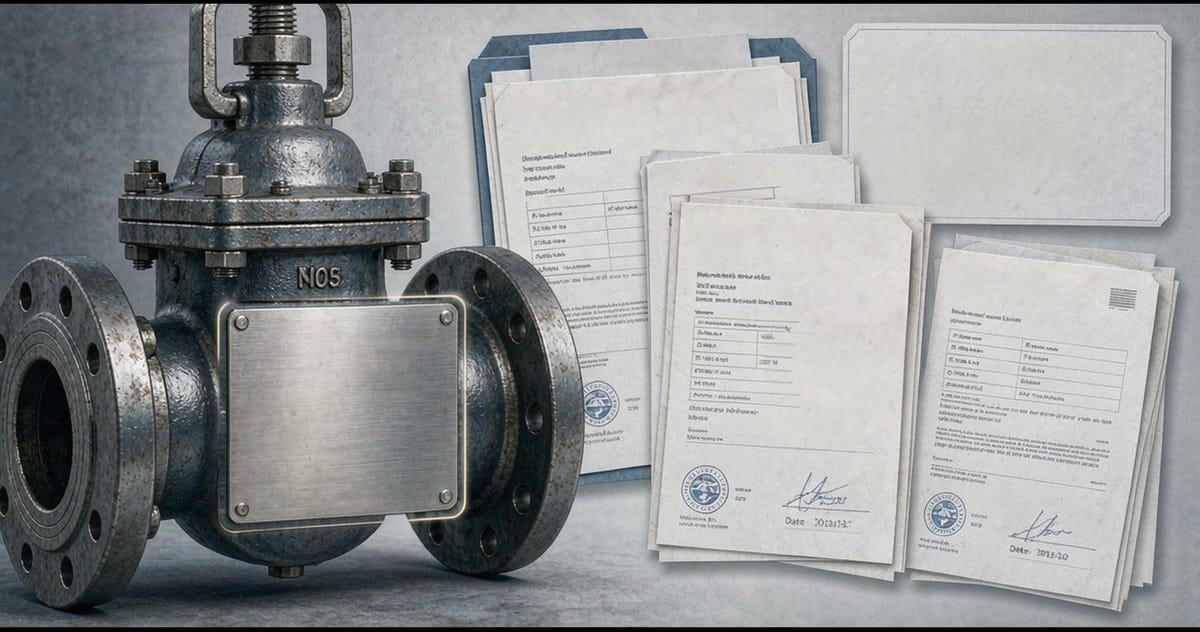
- Technical documentation — the file that demonstrates conformity must be compiled and retained; the purchaser's right to see it is what turns a CE mark from a sticker into evidence.
The CE Mark and What It Does Not Mean
When a valve is CE-marked under PED, the marking is accompanied — for Categories II, III, and IV — by the identification number of the notified body that participated in the production control phase. The mark asserts that the applicable conformity assessment procedure was completed and that the valve satisfies the essential safety requirements when used within its stated limits. It does not assert performance qualities beyond that: a CE-marked valve can still leak through its seat, still have a soft seal unsuited to the media, and still be the wrong valve for the job. Purchasers who treat CE marking as a substitute for a performance specification are asking the directive to do something it never promised.
How PED Differs from the ASME System
Engineers trained in the ASME world often try to map PED onto it, and the mapping misleads. ASME B16.34 defines pressure-temperature ratings and material requirements for valves as a product standard; PED is a legislative framework with conformity modules, third-party involvement scaled to hazard, and a declaration that attaches legal responsibility to the manufacturer. The differences worth internalizing:
- ASME ratings are design tables; PED categories are legal conformity routes.
- ASME relies on material standards acceptance; PED may require a PMA for materials outside the approved European list.
- ASME qualification of welding is by code section; PED requires approval of procedures and personnel by the mandated third party for higher categories.
- There is no ASME equivalent of SEP — the concept of placing equipment on the market under sound engineering practice without third-party marking is distinctly European.
Export projects engineered to European rules should expect the PED documentation regardless of where the valves are physically made; the directive applies to the place of sale into the EU, not the place of manufacture.
The Documents a European Project Will Request
A tidy PED file for a valve delivery should include:
- The EU Declaration of Conformity naming the directive, the conformity category and module applied, and the notified body.
- The technical file reference: calculations, drawings, and the hazard analysis.
- Material certificates for pressure parts — EN 10204 type 3.1 at minimum, with PMA or EAM references where applicable.
- Welding procedure qualification records and welder qualifications, approved as required by the category.
- Final assessment records and the pressure test report.
- Operating instructions in the required languages, with the allowable limits clearly stated.
Requesting this list at purchase order stage, rather than after delivery, is the cheapest quality intervention available on a European valve package.
Closing the Compliance Loop
PED compliance is procedural, but it is not paperwork for its own sake — each module enforces a real engineering check, from material approval to weld qualification to final proof test. An experienced manufacturer that produces the full valve range in-house — ball valves, control valves, gate valves, globe valves, check valves, strainers, knife gate valves, plug valves and butterfly valves — can deliver each line with the correct PED category assessment, a complete technical file, and the declaration matching the fluid group and category in your Valve Schedule. Send the schedule or the key parameters for each position to the manufacturer's applications team for a per-line proposal with the conformity route identified upfront.