Live-Loaded Packing: Keeping Stem Seals Tight Over Time
How live-loaded packing with Belleville springs maintains stem seal tightness in valves, plus material choices, low-emission design, and maintenance guidance.
Live-Loaded Packing: Keeping Stem Seals Tight Over Time
Gland packing is the oldest sealing method in the valve industry, and it is still the one most likely to cause a leak call-out five years after commissioning. The reason is rarely bad packing. It is relaxation. A conventional gland that is torqued correctly on day one will almost always lose load over time, and once the load drops far enough, the stem seal starts weeping. Live-loading exists to solve exactly this problem, and it remains one of the highest-value upgrades available for valves in cyclic, hot, or emission-critical service.
Why Conventional Packing Relaxes
To understand live-loading, start with why a normal gland fails to stay tight. The packing set in a stuffing box is a stack of rings compressed axially by the gland flange. That axial compression translates into radial contact pressure against the stem and the box wall, which is what actually blocks leakage. The problem is that everything in this stack wants to move.
- Wear at the stem interface. Every stroke rubs the inner bore of the packing against the stem. Stem travel in a rising-stem gate valve or a rotating quarter-turn stem gradually polishes away the packing's inner surface, so the rings lose thickness and the compression load decays.
- Cold flow. Soft packing materials — PTFE most famously, but also many fiber compositions — creep under sustained compressive load, especially at elevated temperature. The rings slowly squeeze thinner even when the valve is not moving at all. PTFE at a steam-line temperature can lose a significant share of its loaded thickness within the first months of service.
- Thermal cycling. Heat expands the stem and the box; cooling contracts them. Each cycle changes the clearances and can shake loose the friction that held the packing in its compressed state. Plants in cyclic service see gland leakage appear far earlier than plants on steady service.
- Bolt relaxation and gasket creep. The studs and the gland-flange gasket themselves relax after initial tightening, which subtracts load before the packing even feels it.
The consequence is familiar to any maintenance planner: a valve that was tight at handover needs a gland wrench every few months, and in emission-monitored service it eventually fails the leak check.
The Live-Loading Principle
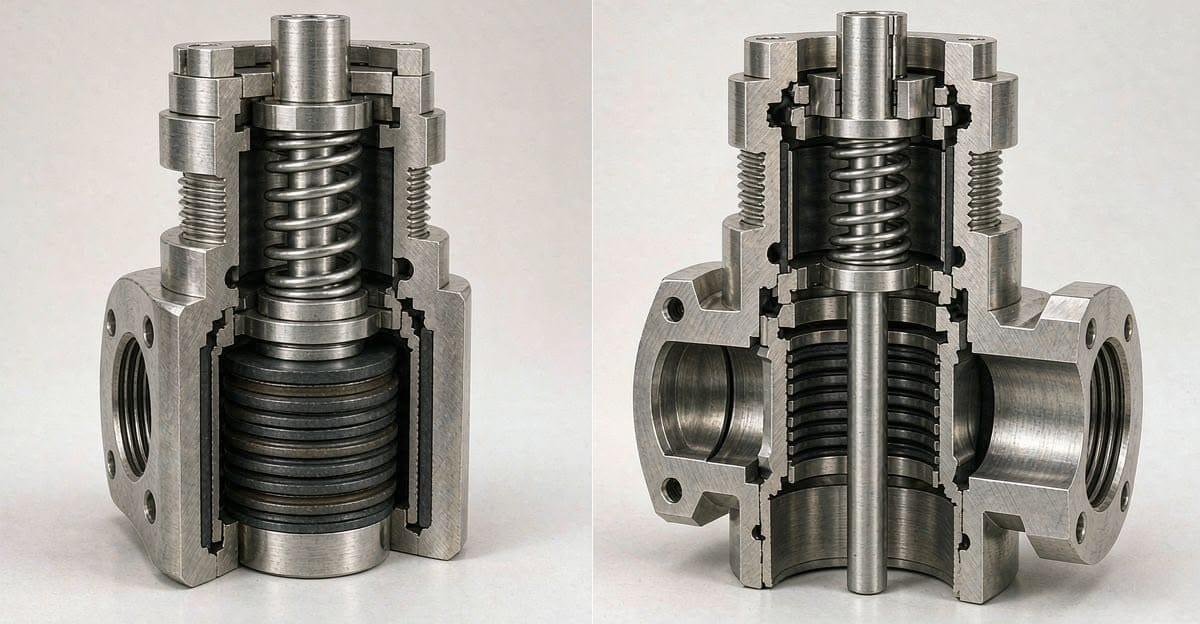
Live-loading replaces the fixed stiffness of the gland-flange bolting with a controlled spring force. A stack of Belleville washers — conically shaped disc springs — is installed on the gland studs, between a hardened washer and the gland flange. The bolting is tightened until the Bellevilles deflect into their working range, and from that point on the gland load comes from the spring stack rather than from the bolt stretch alone.
This changes the behavior fundamentally. Belleville washers have a very flat force-deflection curve in their useful range, so the load they deliver changes little even when the packing compresses further by a fraction of a millimeter. As the packing wears or creeps, the spring stack simply extends slightly and keeps pushing. The gland stays loaded without anyone touching it — the "live" in live-loaded.
Two practical selection points matter more than the rest:
- Deflection margin. The stack must be sized so that the total travel it can absorb exceeds the packing's expected consolidation and wear over the maintenance interval. If the springs reach flat — full deflection — they become a hard stop and the benefit disappears. Undersized live-loading is worse than none, because it hides the problem until the stack bottoms out.
- Load calibration. The stack is tightened to a defined deflection, often verified by measuring the gap under the washer. Some designs use a load indicator washer that shows when the target force is reached. An installer who simply runs the nuts down until they feel tight has defeated the whole concept.
Packing Material Combinations
Live-loading does not excuse a bad packing set. It works with it, and the material selection still drives temperature rating, emission performance, and friction behavior.
- Flexible graphite rings. Die-formed flexible graphite is the default for steam, hydrocarbons above PTFE's temperature comfort zone, and any service where fire safety matters. Graphite does not cold-flow the way PTFE does and tolerates thermal cycling well. Its weakness is porosity and its vulnerability to oxidizing media at high temperature, so it is rarely used alone.
- PTFE and filled PTFE. Virgin PTFE seals tightly and runs with low stem friction, which actuators appreciate. Glass- or carbon-filled grades improve creep resistance and thermal stability. PTFE remains the right answer for cold service, strong acids, and general utility lines — but it is the material that most needs live-loading, because its cold flow is precisely the problem the springs compensate for.
- Braided corner rings. A common construction puts braided, fiber-reinforced rings — aramid, graphite yarn, or carbon yarn — at the top and bottom of the set, with die-formed graphite or PTFE rings in the middle. The braided rings resist extrusion into the clearances at the gland and the bottom of the box, and they bridge the porosity of the molded rings. This end-ring-and-center arrangement is the standard architecture for emission-critical applications.
- Anti-extrusion and wipe rings. In slurry or flashing service, intermediate lantern rings or dedicated wipe rings keep solids out of the box and keep the sealing surfaces clean.
Material must also match the stem finish. Live-loading maintains force, but if the stem surface is rough or corroded, no amount of spring load stops the wear that follows. Hard-faced or finely finished stems with controlled surface roughness are part of the sealing system, not a separate topic.
Fit with Low-Emission Programs
Fugitive emission regulations in refining and petrochemical service have pushed packing design hard. Modern low-emission packing sets are tested to certification schemes that measure leakage at the stem over repeated mechanical and thermal cycles, and virtually every serious low-emission design depends on sustained gland load to pass those cycles.
Live-loading and low-emission packing are natural complements. The certified packing gives you a seal architecture with proven leakage performance; the Belleville stack gives you confidence that the load which existed at the certification test still exists in the plant after a season of cycling. Specifying one without the other, on a valve in LDAR-monitored service, usually means the monitoring program will find the gap.
Maintenance and Replacement
Live-loading does not eliminate maintenance; it stretches the interval and makes the remaining work more predictable.
- Check the stack, not just the gland. At shutdown, verify the springs still carry deflection and are not corroded, cracked, or flat. Disc springs that have sat hot for years can lose set. Any stack with visible rust scale or lost free height should be replaced — the springs are cheap relative to the leak they prevent.
- Treat the packing as consumable. When the valve is serviced, replace the full set rather than adding a ring on top. Topping up compresses the old, hardened rings into a non-uniform stack and destroys the load geometry the live-loading was calibrated for.
- Retorque to the defined deflection. After repacking, tighten to the manufacturer's stated spring gap or load-indicator position, not to a generic torque figure.
- Watch stem condition. A stem that has been running against degraded packing may have scored the sealing surface. Polishing or replacing the stem at repack intervals is usually justified on critical valves.
Where the Cost Pays Back — and Where It Does Not
A live-loaded gland adds hardware and assembly time, so it is not free. The honest economic case looks like this. On a utility water line in steady service with periodic operator rounds, a conventional gland adjusted by a fitter is perfectly adequate, and live-loading spends money where the risk is small. On steam, hot hydrocarbons, cyclic service, or anything inside an emission-monitored boundary, the math reverses quickly: one avoided emission work order, or one avoided unplanned shutdown for a weeping gland, covers the upgrade. The judgment call belongs in the valve schedule, made line by line.
Confirming the Configuration with the Manufacturer
When specifying, put the burden of proof on the design: ask for the spring stack's load-deflection data, the packing's temperature and cycle rating, and any emission test documentation for the combined packing-plus-live-loading arrangement. An experienced manufacturer that produces the full valve range in-house — ball valves, control valves, gate valves, globe valves, check valves, strainers, knife gate valves, plug valves and butterfly valves — can support this review with packing material datasheets and test reports. Send your Valve Schedule or the key parameters for each position to the manufacturer's applications team for a per-line proposal.