Knife Gate vs Conventional Gate Valves: Where the Line
Knife gate and conventional gate valves compared: pressure ratings, size ranges, solids handling, sealing design, standards, weight and cost, maintenance, and where the selection line falls.
Knife Gate vs Conventional Gate Valves: Where the Line Splits
Both are called gate valves. Both lower a flat or wedge-shaped barrier into the flow path and are meant for full-bore, straight-through service with little pressure drop. That is roughly where the kinship ends. A conventional gate valve and a knife gate valve are engineered for different fluids, different pressures, different budgets, and different kinds of failure. The most expensive mistakes in piping procurement come from using one where the other belongs — a knife gate where line pressure demands a pressure-rated body, or a heavy API gate where a slurry would jam it within weeks. This article draws the boundary precisely.
Two Different Design Philosophies
A conventional gate valve is a thick-walled, pressure-rated block valve. Its closure element is a wedge or parallel disc that seats into machined body seats; the body holds line pressure across the full spectrum of hydrocarbon and process services, with pressure classes following the established flange rating ladder. It is a device for clean-to-moderately-clean fluids where tight shutoff and pressure integrity are the point.
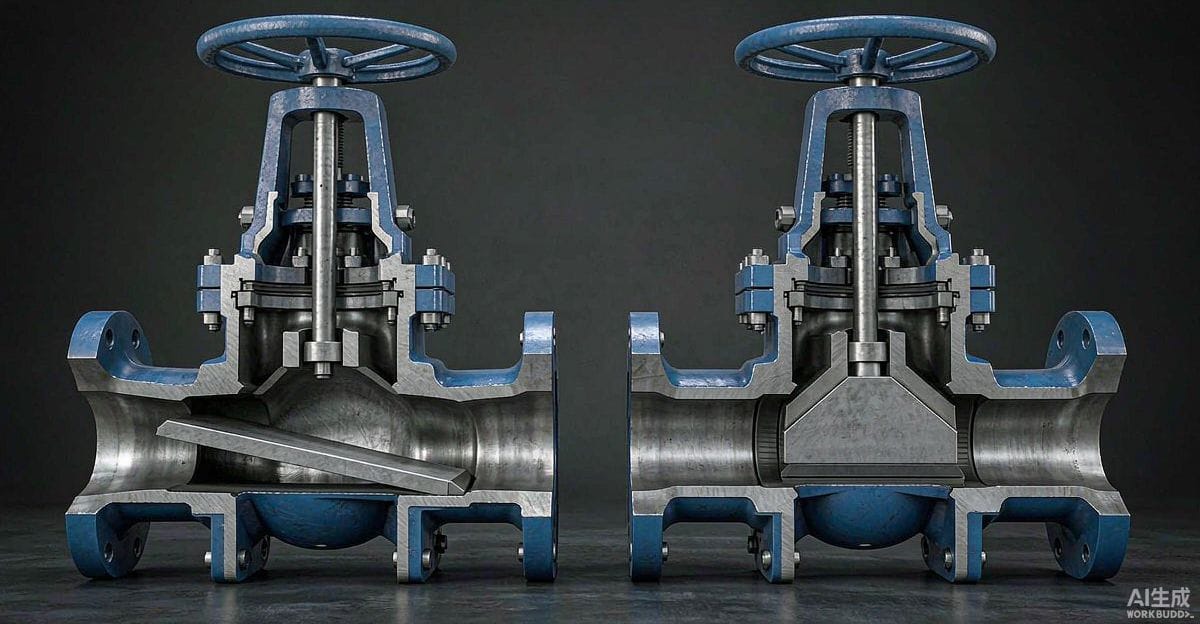
A knife gate valve is a thin, blade-like plate that slices through the flow path and, at the bottom of its stroke, seats against an elastomer sleeve or seal. The body is short, often wafer-type, and comparatively light. Its purpose is fundamentally different: to cut through, and isolate, media containing solids — pulp stock, sludge, slurry, powders, wastewater, tailings. It is a device for guillotining a dirty stream and sealing it off.
The geometry tells the story. The knife gate's blade is thin and sharpened or chamfered precisely because it must physically cut through fibrous or particulate material. The conventional gate's wedge is massive because it must wedge itself into tapered seats and maintain sealing under pressure differential.
Pressure and Size Envelopes
The pressure boundary is where the two families separate most sharply:
- Conventional gate valves are made across the full pressure class range — Class 150 through 2500 and beyond, including pressure-seal bonnet designs for high-pressure steam — and in sizes from small bore up to very large.
- Knife gate valves are predominantly low-pressure devices. Typical designs serve up to the mid-range of common flange classes, and many wafer bodies are suited only to modest differentials. Special high-pressure knife gate designs exist, but they are the exception, not the family's territory.
In size, the ranking flips. Knife gate valves are most at home in large bores — where their light, wafer construction makes them dramatically cheaper and easier to handle than a cast gate valve of the same bore — while conventional gate valves below mid-size are standard catalog items everywhere.
Media: Clean Versus Solids-Laden
This is the true selection axis. Where the fluid is clean — steam, condensate, hydrocarbon vapor, treated water, refined products — the conventional gate valve is nearly always the right answer. Its tight seats, pressure integrity, and wide standards coverage fit the duty.
Where the media carries solids, the knife gate earns its keep:
- Pulp and paper stock lines, where fibers bind and jam a wedge gate's seating faces.
- Mining tailings and mineral slurry, where abrasion tolerates no pockets or cavities.
- Wastewater and sludge, where stringy material wraps around anything with internal cavities.
- Dry bulk, silos, and hopper isolation, where the blade serves as a slide gate.
Put a conventional gate valve in these services and the failure mode is predictable: the wedge's cavity collects solids, the valve cannot reach the seat, and the valve must be cut out of the line. Put a knife gate on a high-pressure clean steam line and the failure mode is equally predictable: the elastomer seal and thin wafer body are not built for that duty, and the consequences arrive quickly.
Sealing: Direction, Tightness, and What "Bubble-Tight" Means Here
Conventional gate valves seal metal-to-metal (or with inserted seats) into machined body seats, and good designs achieve tight shutoff for clean fluids; resilience is limited and seat tightness degrades with wear and thermal cycling.
Knife gate valves seal the blade against a replaceable elastomer sleeve or seat. Design variations matter at selection time:
- One-way (unidirectional) sealing — the elastomer seat is on one side; the valve must be installed with the pressure direction correct, and reversal turns a shutoff valve into a leak.
- Two-way (bi-directional) sealing — sealing on both faces, essential where flow direction can reverse or the valve sits between different pressure sources.
- The elastomer is both the strength and the weakness: excellent seal, but it is the first wear item and must be replaceable in-line.
For leakage class expectations, a sound knife gate on suitable service can seal tighter than a worn metal-seated gate — but only while the elastomer is intact.
Standards Coverage
The standards landscape reflects the split. Conventional gate valves sit inside a mature framework — API 600 and its related bolted-bonnet steel gate specifications, the flanged and butt-welding gate standards from ASME and ISO, and face-to-face and testing standards that give purchasers well-defined envelopes.
Knife gate valves follow a separate, thinner set of standards — dedicated specifications covering face-to-face dimensions, testing, and marking — with less uniformity across regions and manufacturers. Interchangeability between makers is therefore less guaranteed: face-to-face dimensions, flange drilling, and seal design should be checked explicitly on retrofit projects, and the applicable standard named on the purchase order rather than assumed.
Weight, Cost, and End Connections
On large bores the difference is striking. A wafer knife gate of large diameter weighs a fraction of the flanged cast gate equivalent and needs less structural support, transport, and installation labor. The purchase price follows the same pattern. On small bores at conventional pressure classes the comparison reverses — the standard gate valve wins on pressure capability, availability, and standards coverage.
Connection styles follow duty: wafer and lug knife gates squeeze between flanges; conventional gates are flanged, butt-welded, or threaded, and the welded pressure-boundary joints are part of their high-pressure legitimacy.
Maintenance: Replace the Sleeve or Rebuild the Wedge
The maintenance models differ in kind:
- Knife gate: the wearing parts — elastomer sleeve, blade edge, packing — are accessible and often replaceable in line. Re-seating means replacing a sleeve, not machining.
- Conventional gate: seat reconditioning means lapping, machining, or body refurbishment, usually with the valve off the line and in a workshop. The valve's expected life is longer.
The knife gate's economy is bought with a shorter service interval; the conventional gate's cost is amortized over decades of pressure integrity on clean service.
Misuse Cases Worth Learning From
The recurring errors seen across plants:
- Knife gate on a steam or hydrocarbon line because "it is a gate valve and cheaper" — the elastomer seat and low-pressure body are simply not that duty.
- Conventional wedge gate on fiber-bearing stock — the wedge cavity packs out and the valve never closes again.
- Unidirectional knife gates installed against the flow arrow — discovered the first time the line reverses.
- Knife gates chosen for throttling — a knife gate is an isolation device; partially open service erodes the blade and the sleeve, and modulating service belongs to control valves or purpose-built pinch or diaphragm devices.
- Specifying a knife gate for vacuum duty without checking the sleeve's vacuum rating — elastomer seats can be drawn away from the blade under external pressure.
The Selection Line
A compact rule set:
- Clean media, meaningful pressure, standards-driven procurement: conventional gate valve per API 600 or the applicable flanged/welding gate standard.
- Solids, fibers, slurry, sludge, dry bulk, large bore, low pressure, weight-sensitive installation: knife gate valve, with bi-directional sealing where flow direction is not fixed.
- Anything requiring throttling: neither — specify a control or regulating valve.
- Retrofit or replacement in knife gate service: verify face-to-face and seal design against the installed valve, not the catalog average.
Choosing with Manufacturer Support
Both families sit inside a broader isolation strategy, and the boundary cases — moderate pressure with occasional solids, abrasive slurries at elevated pressure, bidirectional isolation with double block and bleed expectations — deserve a second opinion before the purchase order is cut. An experienced manufacturer that produces the full valve range in-house — ball valves, control valves, gate valves, globe valves, check valves, strainers, knife gate valves, plug valves and butterfly valves — can review each isolation duty in the valve schedule, recommend the correct family per line, and quote both where the boundary is genuinely ambiguous. Send the line list with media, pressure, and temperature for each position to the manufacturer's applications team for a per-line proposal.