ISO 5208 vs API 598: Valve Leakage Testing Compared
How ISO 5208 and API 598 differ in scope, leakage grades, test media, test pressure and directionality — and how to reference them correctly in a valve purchase specification.
ISO 5208 vs API 598: Valve Leakage Testing Compared
Two purchase orders can call for the "same" valve and yet receive valves tested to different acceptance criteria. Valve leakage testing is one of the most frequent sources of friction between buyers and manufacturers, and it usually traces back to how the specification references ISO 5208, API 598, or neither of them clearly. This article compares the two standards, explains how their leakage grades relate, and shows how to write a specification that leaves no room for argument.
What Each Standard Actually Is
ISO 5208 is the international standard for pressure testing of industrial valves. It defines the test methods, test pressures, durations and acceptance criteria (leakage rates) for shell and seat tests across the broad family of industrial valves — gate, globe, check, ball, butterfly, plug and diaphragm valves alike. Its leakage grading system, with grades identified by letters, has become the common vocabulary of the industry.
API 598 is the American Petroleum Institute's standard for valve inspection and testing. It covers valve repair as well as new production, and it has long been the default reference in refinery piping specifications. Its acceptance-rate tables predate ISO 5208's grading scheme, which is exactly where most of the confusion arises.
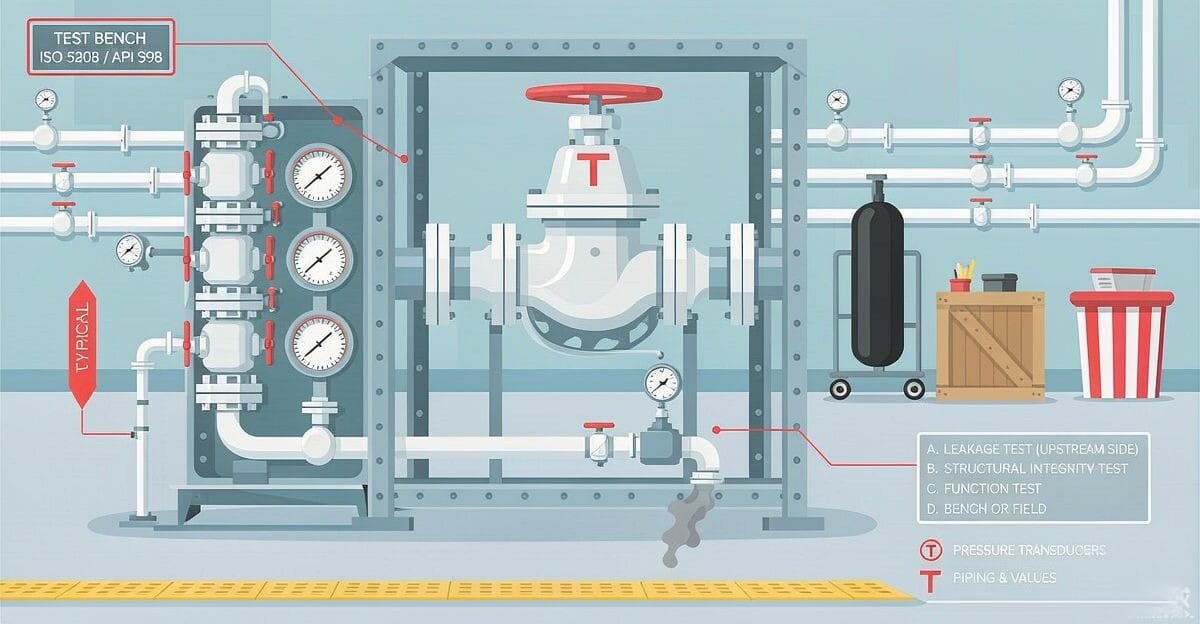
Both standards test the same things: pressure-retaining capability of the shell (body, bonnet, closure members, gland), and the sealing capability of the seats — typically at high pressure with liquid, at low pressure with air or gas, or both, depending on design and service.
Leakage Grades and Their Correspondence
ISO 5208 defines a ladder of leakage rates:
- Grade A — no visible leakage through the seat during the test duration. This is the practical requirement for most soft-seated valves.
- Grades B, C and D — defined leakage rates expressed in relation to the nominal size of the valve, with different rates for liquid and gas testing. Grade D is the rate most commonly associated with metal-seated valves in standard service.
API 598, in parallel, contains its own acceptance-rate tables — leakage in drops of liquid per minute or bubbles of gas per unit time, scaled by valve size. The engineering shorthand that has grown up around the two is that ISO 5208's Grade D corresponds broadly to the API 598 acceptance for metal-seated valves, and Grade A is tighter than anything API 598 requires by default. But "broadly" is the operative word: the numbers are close, not identical, and the conversion depends on valve size and test medium. A specification that says "tested per API 598, seat leakage equivalent to ISO 5208 Grade A" mixes two vocabularies and invites dispute.
Test Media and Pressures
The two standards use similar test families but define them differently:
- Shell test — hydrostatic, at a specified multiple of the rated pressure, held for a duration that scales with valve size. Small valves in the range where air testing is practical may be shell-tested pneumatically at reduced pressure instead.
- High-pressure seat test — with liquid for liquid service, or gas at a specified fraction of rated pressure where the design or service demands it.
- Low-pressure seat test — with air at a modest pressure, applied because a valve that seals against full process pressure may still weep at low differential — the classic failure mode discovered during tank blanketing or low-flow service.
One frequently missed point: for double-seated designs such as ball and gate valves, seat tests are performed on each seat individually unless the valve is qualified for double block and bleed service, in which case the test and acceptance criteria change.
Metal Seats versus Soft Seats
The grade you can expect depends heavily on the seat material:
- Soft seats (PTFE, nylon, reinforced elastomers) routinely achieve Grade A at low pressure with air, and manufacturers will typically commit to Grade A for both low- and high-pressure seat tests as a standard offer.
- Metal seats cannot promise zero leakage; the realistic commitment sits in the higher-letter grades at low pressure. Buying a metal-seated valve and demanding Grade A is a common, avoidable negotiation failure — the correct route is either a higher grade by special design and 100 percent testing, or acceptance of the appropriate grade.
- Fire-tested soft seats after exposure are a separate matter entirely; the fire-test standards impose their own post-burn leakage criteria, which are more permissive than the as-new grades.
The Relationship to FCI 70-2
FCI 70-2 governs control valve seat leakage and uses class designations from Class I through Class VI, culminating in the bubble-tight Class VI measured by gas flow. It is a control-valve standard, not a manual-valve standard, but specifications frequently reference it — sometimes correctly, sometimes not. Roughly speaking, ISO 5208 Grade A aspiration is comparable in spirit to Class VI tightness, while the middle ISO grades sit near Class II–IV territory for metal seats. The comparison is directional, not exact: test pressures, media and measurement methods differ, so the classes and grades are not interchangeable. The practical rule is to cite the standard that matches the valve type — ISO 5208 or API 598 for isolation valves, FCI 70-2 for control valves — and not blend them.
Directionality of Testing
Seat leakage is directional. A gate valve wedge seals against both seats, a ball valve's self-relieving seat may seal tightly upstream but relieve downstream, and a swing check valve seals in one direction only. ISO 5208 specifies the direction in which seat tests are applied and recognizes designs with defined sealing direction. Purchasers who expect bidirectional sealing must say so — a valve can pass its standard test and still not meet an unstated bidirectional expectation.
How to Write It Into a Specification
A clean leakage clause contains only a few elements:
- Cite one primary standard (ISO 5208 or API 598) — do not blend acceptance tables.
- State the seat leakage grade explicitly for soft and metal seats separately.
- State whether bidirectional sealing is required and whether the valve must meet DBB/DIB seat-test criteria.
- Specify test witnessing and documentation requirements, including test reports per size and type.
- For special services — cryogenic, high differential, abrasive — call out supplementary tests rather than tightening the base grade arbitrarily.
Disputes almost always come from specifications that are silent on one of these points, then enforced after delivery at the buyer's newly chosen interpretation.
Closing the Loop with Manufacturer Support
Leakage grading is easy to specify correctly and expensive to get wrong after delivery. An experienced manufacturer that produces the full valve range in-house — ball valves, control valves, gate valves, globe valves, check valves, strainers, knife gate valves, plug valves and butterfly valves — can review the testing clauses of a valve specification, propose achievable grade and test-media combinations for each seat design, and supply full test reports for every position. Send the valve schedule or the key service parameters for each line to the manufacturer's applications team for a per-line proposal.