Fire Testing of Valves: API 607 and API 6FA Compared
What fire-safe valve certification really means. Compare API 607 and API 6FA test conditions, burn temperature, cooling water pressure, leakage acceptance and certification scope.
Fire Testing of Valves: API 607 and API 6FA Compared
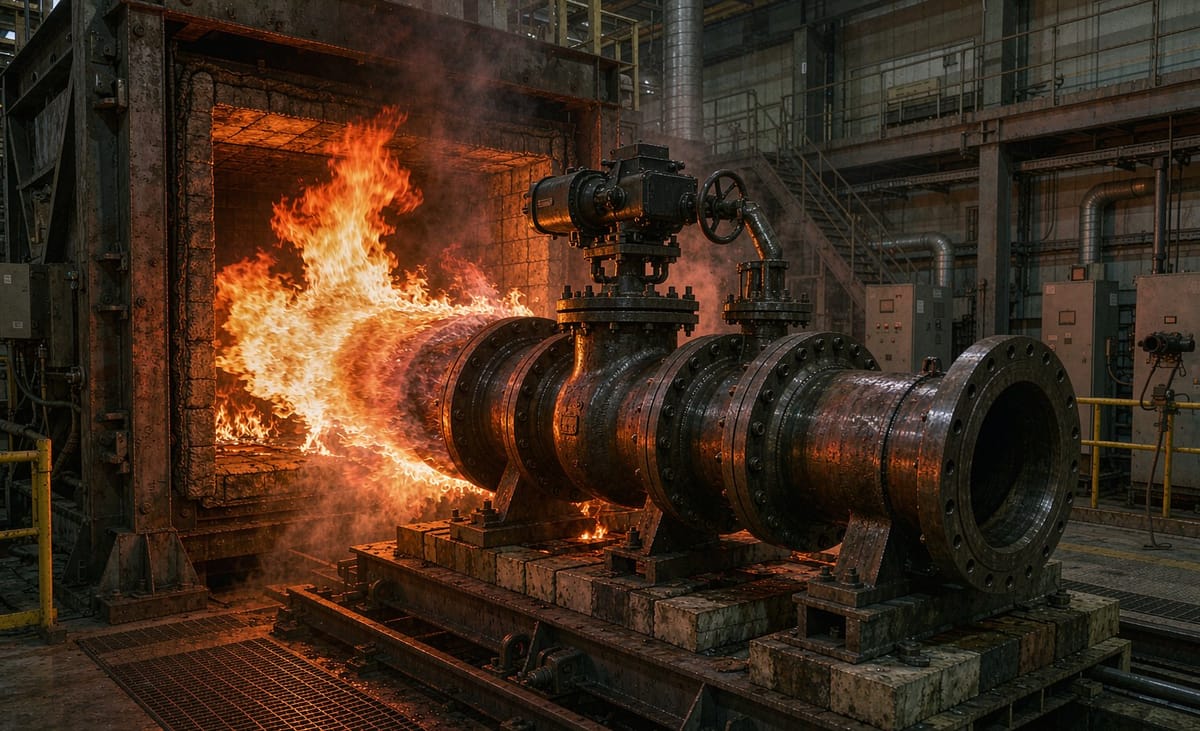
"Fire-safe" may be the most misunderstood phrase in valve procurement. It does not mean the valve survives a fire intact, and it does not mean the valve keeps its original, bubble-tight sealing. It means something narrower and more useful: when a soft-seated valve is engulfed in flame, the soft seat is destroyed — and the valve must still close reasonably tight, through metal-to-metal contact, until the fire is out and the line can be made safe. This article explains the design logic behind fire testing, then compares the two dominant test standards, API 607 and API 6FA, and clears up the misconceptions that cost projects money.
The Design Logic: Temporary Sealing After the Seat Is Gone
Soft-seated valves — most ball, plug and butterfly valves, and many gate designs with resilient inserts — seal superbly in normal service because the polymer seat conforms to the closure member. But polymer burns. The fire-safe concept is therefore a fallback architecture, not an upgrade:
- Under flame exposure the soft seat decomposes, burns away or is blown out by the escaping gas.
- The valve's geometry then brings the ball, disc, gate or plug into direct contact with a metallic secondary seat surface — often the body itself, a metal seat ring, or an auxiliary spring-loaded metal seal.
- Leakage through this metal-to-metal interface is accepted, but strictly limited: the valve must not feed the fire.
- External tightness matters as much as internal: stem seals and body joints must limit external flame and leakage while burning and while pressurized and hot.
So a fire-tested valve is a valve with a designed, qualified failure mode. The qualification is exactly what the two standards in question define.
API 607: Soft-Seated Quarter-Turn Valves
API 607 is the standard most specifications cite for fire testing of soft-seated quarter-turn valves — ball valves above all, but also plug and butterfly valves in its scope. The test is a full-burn, full-pressure ordeal conducted on a complete valve assembly, closely aligned with the international fire-test method ISO 10497.
The essential conditions:
- Burn phase. The valve, assembled with its closure operator, is exposed to flame around the body and is burned until the flame temperature envelope reaches the required range — in the order of several hundred degrees Celsius at the valve surface, with a defined burn duration measured in minutes, not seconds.
- Pressure held during burn. The test valve is pressurized with water (or another specified medium) during the burn, and external leakage is measured as the valve burns.
- Cooling and re-pressurization. After the burn, the valve is quenched with a water spray and then subjected to a hydrostatic leak test at a specified fraction of its rated pressure — historically around three-quarters — while the internal leakage rate is collected and measured against the acceptance table.
- Operability. The valve must still be operable after the burn — the actuator or lever must be able to cycle it. This is often overlooked: a fire-safe valve that has welded itself shut has failed the spirit of the test.
- Additional phases. Some test procedures include a second leak measurement after a period at reduced pressure and a check of the seat after thermal cycling, depending on the version and the purchaser's requirements.
Acceptance is a leakage rate per unit of valve size — small but nonzero — for both internal and external leakage. Passing valves are certified by the test witness and, when third-party certification is involved, carry a type-approval certificate covering a defined size and pressure-class envelope.
API 6FA: Pipeline Valve Fire Testing
API 6FA is API's fire-type test for valves in pipeline service — the scope aligns with API 6D's valve families: ball, gate and plug valves, both soft-seated and metal-seated in practice. It was developed for pipeline operators who needed their block valves, ESD valves and launcher or receiver valves qualified under pipeline conditions.
The comparison with API 607 comes down to a few practical differences:
- Scope of valve types. API 6FA covers the API 6D valve families and their operating conditions; API 607 is framed around soft-seated quarter-turn valves. A metal-seated pipeline gate valve will typically be qualified to API 6FA rather than API 607.
- Test specimen and coverage. Both standards use a representative test valve and extrapolate the approval across a size and class envelope, but the envelope definitions differ. A certificate to API 607 at one size does not automatically cover a much larger pipeline valve to API 6FA logic.
- Test conditions. Both use fuel-fired burn with measured temperature envelope, pressurized burn, water quench, and post-burn leakage acceptance at a defined fraction of rated pressure. The details — duration, pressure fractions, instrumentation and leakage collection — are specified differently, and results are not interchangeable between the two certificates.
- Application context. API 6FA is normally requested where the valve also carries API 6D pedigree; API 607 accompanies API 608 and general-service soft-seated valves.
In many project specifications both appear: the line list may demand fire-safe qualification "per API 607 or API 6FA" — which is fine as long as the purchaser accepts the certificate the manufacturer already holds for that size and design.
Certification, Type Testing and Coverage
Fire testing is expensive and destructive; it is therefore a type test, not a production test:
- A manufacturer qualifies a representative valve — a particular size and pressure class — and the certificate covers a defined range around it, per the standard's coverage rules.
- Third-party witnesses (classification societies and notified certification bodies) issue the type certificates that operators actually audit against.
- The buyer's job is to check that the certificate in hand actually covers the ordered size, class and seat design. A certificate for a floating-ball design does not cover a trunnion valve; a certificate at one class does not automatically cover a higher class.
- Production valves that inherit the qualification are not individually burned — they inherit it by design conformity, which is why design-change control at the manufacturer matters to the validity of the certificate.
Selection Boundaries and Common Misconceptions
Keep these distinctions sharp when writing or reviewing specifications:
- Fire-tested is not fireproof. The valve leaks (within limits) after a fire and may need repair or replacement afterward. The purpose is emergency isolation, not uninterrupted service through a blaze.
- The certificate is for the assembled valve. A fire-safe seat insert does not make the valve fire-safe; stem sealing, gaskets and operator mounting are all part of the tested assembly.
- Post-fire torque rises. A valve that has been burned takes more torque to operate — actuator sizing on fire-safe service should account for this, and some specifications demand post-burn operability at elevated torque.
- Metal-seated valves still get tested. Even nominally metal-seated designs contain soft components (packing, gaskets) and are qualified to prove acceptable post-burn leakage.
- Match the standard to the service context. Plant isolation valve → API 607 certificate. Pipeline ESD or block valve → API 6FA (or the project's equivalent combination).
Getting Certificates Matched to the Valve Schedule
Fire-safe qualification lives or dies on certificate coverage, and that check is best done before purchase orders are cut. An experienced manufacturer that produces the full valve range in-house — ball valves, control valves, gate valves, globe valves, check valves, strainers, knife gate valves, plug valves and butterfly valves — can match each valve schedule line to a valid fire-test certificate for the correct size, class and design, and supply the type-approval documents the operator's audit will require. Send the valve schedule or the key parameters for each position to the manufacturer's applications team for a per-line proposal.



