Cryogenic Valve Testing: BS 6364 and Extended Bonnet
How BS 6364 cryogenic valve testing works — liquid nitrogen immersion, temperature stabilization, low-temperature seat tests, extended bonnet design, and what to verify before you buy.
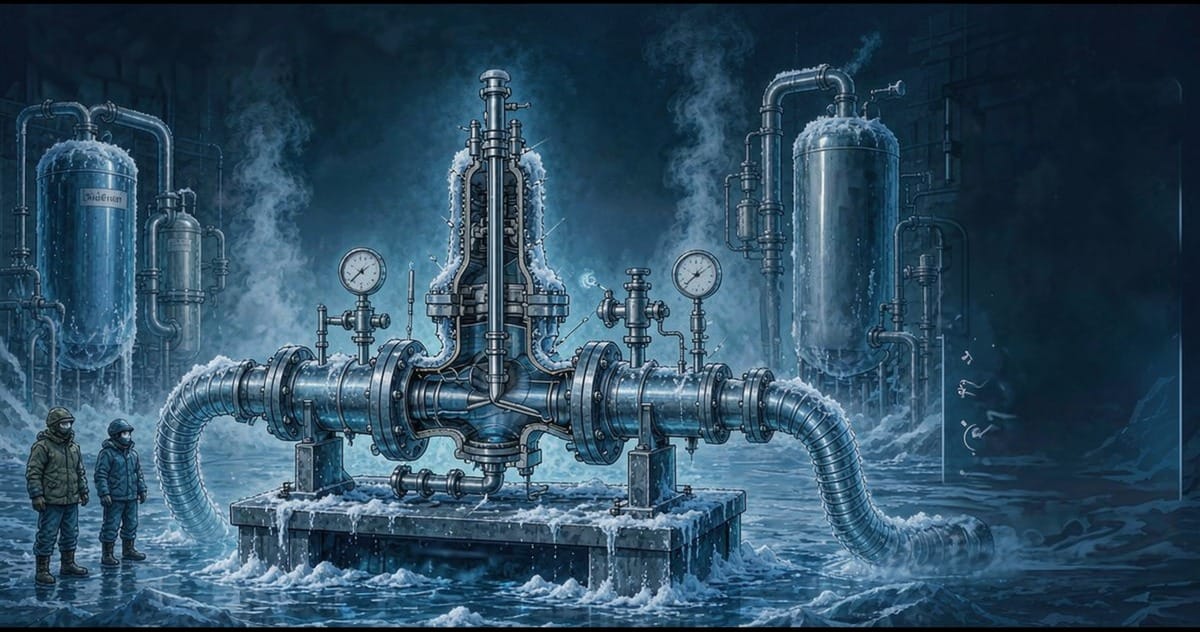
Cryogenic Valve Testing: BS 6364 and Extended Bonnet Qualification
A valve that seals perfectly on the test bench at ambient temperature can fail badly at −162 °C. Elastomers glass and crack, metal seats shrink away from their mating surfaces, packing loses its load, and bodies that were sound at room temperature develop leaks through welds and castings as thermal contraction opens microscopic gaps. This is why cryogenic valves are not merely "low temperature" versions of standard valves, and why BS 6364 — the British standard for cryogenic valve testing — has become the de facto acceptance framework for valves in LNG, liquid nitrogen, liquid oxygen, and ethylene service worldwide.
Why Cold Makes Sealing Hard
The core problem is differential thermal contraction. The body, bonnet, seat rings, disc, and bolting all shrink as temperature falls, but they shrink by different amounts because their coefficients of thermal expansion differ and because they reach the cryogenic temperature at different times. A seat interface that was lapped and loaded correctly at ambient can lose its interference entirely at operating temperature. Add the material issues — most elastomers and many polymers are unusable below roughly −50 °C, which is why cryogenic soft seats are limited to PTFE and similar polymers, and why many designs go all-metal — and it becomes clear that low-temperature sealing can only be proven by testing at temperature, never inferred from ambient data.
The BS 6364 Test Sequence
BS 6364 lays out a defined sequence in which the valve is cooled, stabilized, and then tested both for leakage and operability. The typical flow for a shell-and-seat qualification is:
- Preparation and ambient baseline. The valve is assembled as it would be supplied, and ambient seat and body leakage tests are completed first so that any cold-test failure can be attributed to temperature effects rather than pre-existing defects.
- Cooling by immersion. The valve is placed in a cryostat and immersed in liquid nitrogen, with the medium inside the valve as specified. Cooling continues until the cryogenic liquid no longer boils at the valve surfaces — the practical sign that the valve metal has approached the bath temperature.
- Temperature stabilization. After the boil-off subsides, the valve is held to stabilize thermally. This is the step that unqualified workshops skip, and skipping it invalidates everything after: a valve tested "cold" on the outside while its internals are still contracting will show leakage that does not reflect real service.
- Low-temperature seat leakage test. With the valve still at temperature, the seat leakage is measured using the applicable criterion — commonly a bubble or drop-count method for air or nitrogen on the low-pressure side, or a helium-based measurement where the specification calls for tighter criteria.
- Low-temperature operability. The valve is cycled open and closed at temperature to confirm it operates smoothly, does not bind, and develops the required seating torque without excessive effort.
- Warm-up and recheck. After returning to ambient, the valve is re-examined, and seal integrity and operability are confirmed again, since a valve that passes cold but leaks warm indicates mechanical damage such as seat or stem distortion.
Test medium, differential pressures, and acceptance limits are either taken from the standard or — more commonly — made more stringent by the purchaser's specification. LNG projects routinely tighten the bubble-count limits and add helium mass-spectrometry requirements.
Test Equipment and Insulation
A credible cryogenic test requires more than a dewar. The cryostat must be large enough to immerse the valve with the bonnet or extended bonnet orientation as installed, and the instrumentation — thermocouples on the body, seat area, and bonnet — must show where the valve actually is on the thermal curve. Piping connected to the valve needs insulation to avoid artificially warming sections that should be cold, and the leak measurement on the downstream side is typically made through a water film or bubbler so that escaping gas is visible and countable. Workshops that improvise this setup tend to produce optimistic numbers; the difference between a genuine BS 6364 test and a marketing "cold test" is almost always visible in the instrumentation and the stabilization records.
Extended Bonnet Design: More Than a Long Neck
The extended bonnet is the defining feature of a cryogenic valve, and its length is an engineering calculation, not a styling choice. Its purpose is to keep the stem packing and the actuator or handwheel far enough above the cold zone that:
- The packing operates in a region where elastomers or graphite remain functional and do not become brittle.
- The packing box temperature stays above the point where atmospheric moisture would freeze around the stem and seize it.
- Heat input from ambient limits ice formation on the stem within the packing region.
Bonnet extension lengths are commonly tied to the valve's pressure class and bore — longer extensions for larger bores and higher classes — and standards and project specifications provide the minimum dimensions. The cold-region boundary is deliberately placed within the extension so that the column of vapor or gas trapped above the liquid acts as thermal insulation between the cryogenic fluid and the packing. When a valve maker offers an "extended bonnet" without stating the design basis for the extension length, that is a red flag worth pursuing.
Torque, Binding, and Ice
The operability portion of the test exists because cryogenic valves seize in characteristic ways. Stem packing loads that were set at ambient can clamp the stem as metals contract; trapped moisture in the bonnet cavity freezes; and soft seats can grip the disc more tightly at temperature. The cold torque test verifies that the actuator — or the manual operator — can develop seating and unseating torque at temperature with margin. On projects, actuator sizing data should reflect the cold condition, not the ambient condition, and the purchaser is entitled to ask for the measured operating torques from the low-temperature test as sizing evidence.
Helium Testing and Bubble Counting
Two measurement philosophies coexist. Bubble counting on an air or nitrogen test is the traditional method: simple, visual, and adequate for many services. Helium leak testing, typically by mass spectrometry, detects far smaller leak rates and is specified for high-value services such as main LNG cryogenic valves and vacuum-jacketed applications. Helium's small molecule makes it a demanding test gas — a valve that passes a helium criterion at temperature is a genuinely tight valve. The trade-off is cost and bench time, so sensible specifications reserve helium testing for the positions where the consequence of leakage justifies it, and apply bubble-count criteria to the rest.
Verifying a Manufacturer's Cryogenic Capability
Before committing a cryogenic order, the purchaser should verify capability, not just certificates. Reasonable requests include:
- Evidence of a functioning cryogenic test facility: cryostat dimensions, instrumentation, and records of recent tests with dates and valve sizes.
- A sample low-temperature test report showing the cooling curve, stabilization hold time, test media, differentials, and measured leak rates.
- The design basis for extended bonnet lengths, including the cold-region boundary and packing temperature assumptions.
- Material certificates confirming low-temperature toughness for body, bonnet, bolting, and weld materials — impact testing at the minimum design temperature, not just chemical composition.
A specification that merely says "tested per BS 6364" without naming the acceptance limits, the test media for each seal boundary, and the helium requirements where needed leaves too much to interpretation.
Specifying with Confidence
Cryogenic valves punish vague specifications. The purchase documents should state the minimum design temperature, the seat leakage criteria per boundary, the bonnet extension basis, the torque acceptance at temperature, and the extent of helium testing. An experienced manufacturer that produces the full valve range in-house — ball valves, control valves, gate valves, globe valves, check valves, strainers, knife gate valves, plug valves and butterfly valves — can confirm the test plan against those requirements, supply complete cold-test reports, and advise where tighter limits are worth the bench time. Send your Valve Schedule or the key parameters for each cryogenic position to the manufacturer's applications team for a per-line proposal and a test plan you can audit.



