Cold Service Valves: Condensation, Insulation, and Ice
How to specify and install valves in cold service: condensation and ice formation, insulation and vapor barrier design, extended bonnets, ice seizure of stems and actuators, coating selection against CUI, and maintainability.
Cold Service Valves: Condensation, Insulation, and Ice Prevention
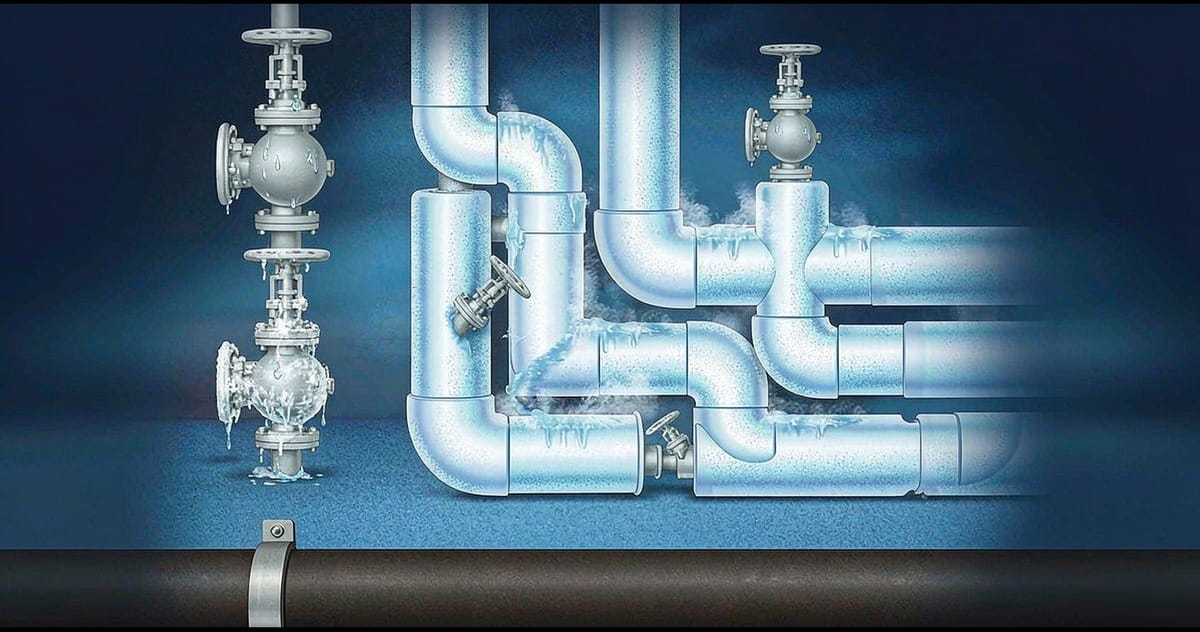
Valves in cold service — refrigeration circuits, liquefied gases, chilled water, LNG and ethylene trains — rarely fail from pressure. They fail from weather. The metal is cold enough to pull water out of ambient air, the insulation never quite covers everything that moves, and the results are familiar to any plant engineer: drips from bonnet flanges, actuators frozen solid, stems seized by ice, and insulation that has quietly rotted from the inside. None of this is exotic, and all of it is preventable at specification and installation stages. This article works through the external problems of cold service valves and the practical measures that keep them operable.
Why Cold Valves Suffer from the Outside
The physics is unglamorous. Any surface below the ambient dew point condenses water; any surface below freezing turns that condensate to ice. A cold service valve has many such surfaces, and the worst of them are exactly the parts that must move:
- The packing area and stem, where any leak of cold process fluid to atmosphere creates local frost that grows and eventually scores the stem.
- The bonnet or body flange, where insulation terminates and a thermal bridge guarantees a condensation ring.
- Actuator mechanisms and limit switch boxes, where ice in the moving clearance converts a functioning valve into a fixed object.
- Bolted joints, where ice expansion and corrosion combine to make future dismantling difficult.
A second, slower mechanism compounds the first: under insulation that has become wet — through vapor ingress, failed seals, or condensation at penetrations — carbon and low-alloy steels corrode at rates far above their atmospheric norms. This is corrosion under insulation, CUI, and it is among the most expensive reliability problems in any plant with cold or cyclic-temperature piping. The insulation is not protecting the valve from CUI; in cold service it is actively creating the wet environment CUI needs, which is why system design matters more than material grade alone.
Insulation and the Vapor Barrier: Design Points That Decide the Outcome
Cold insulation is fundamentally a moisture problem, not a thermal one. Heat loss is easy to calculate; keeping water vapor out of the insulation is what determines whether the system still works in five years. The essentials:
- A continuous vapor barrier on the outside of the insulation, sealed at every joint, penetration, and termination. Water vapor drives inward toward the cold surface and condenses inside the insulation; once wet, most cold-service insulations lose their function and become a corrosion bath.
- Closed-cell materials (cellular glass, certain foams) preferred where moisture exposure is likely, with vapor-permeable or fibrous materials reserved for dry, protected installations.
- Terminations done properly: insulation stops, mastics, and seal details at flanges, valve bodies, and supports are the weak points. A poorly detailed insulation termination at a valve is the single most common entry path for water.
- Provision for inspection. Any insulation scheme that must be destroyed to check a flange will not be checked. Cold service flanges at risk of leakage often justify engineered inspection plugs or removable sections.
For valves specifically, the practical pattern is a removable, jacketed insulation cover over the body, with purpose-built details at the stem and flange penetrations, rather than site-cut slabs taped over with foil.
Extended Bonnets: Why Cold Valves Grow Necks
On cryogenic and deeply refrigerated duties, the extended bonnet is not an accessory; it is how the valve works at all. Its function is thermal: the extended neck puts the stem packing and actuator far enough from the cold body that packing stays above the frost line and the actuator mechanism stays in air that is warmer than its dew point.
The design points that matter:
- Extension length tied to the operating temperature — the colder the service, the longer the neck — and to the orientation of the valve. A valve installed with its bonnet pointing downward collects convecting warm air differently than one with the bonnet upright; cryogenic practice generally requires orientations that avoid trapping liquid or cold vapor in the extension.
- A gas column, not liquid, in the sealed extension; most cryogenic bonnets include a relief provision for trapped vapor expansion.
- Packing choices rated for the cold, since conventional packing compounds stiffen or shrink at low temperature.
- The extension also serves as a structural heat path that must be controlled — solid conduction along the neck is deliberately minimized by material and wall selection.
Skipping the extended bonnet to save length or cost on a cryogenic line is a decision that reappears as frozen packing every winter for the life of the plant.
Ice, Seizure, and Operation
Ice attacks moving parts in two ways: water condensing on cold external surfaces and freezing, and cold process fluid leaking outward through packing and freezing at the stem. Countermeasures are mostly specification and housekeeping:
- Live-loading or spring-loaded packing arrangements maintain stem seal as temperature cycles and packing shrinks — a leaking stem breeds ice.
- Stem finishes and clearances chosen for cold service; ice in a standard clearance can exceed the actuator's breakout torque by a large margin.
- heaters or trace-heated pockets at actuator interfaces where ambient conditions are severe, and protective covers that keep condensate and freezing rain off mechanisms.
- Operational routines: exercising cold-service valves periodically, keeping drip and leak reports closed out, and treating any frost trace on a bonnet as a packing leak, not a curiosity.
For air-actuated valves in cold climates, the instrument air supply itself is a freeze risk — dry air, sloped tubing, and protected positioners belong in the same specification conversation as the valve.
Coatings and Materials Against CUI
Coating selection under insulation is a service decision, not a cosmetic one. The environment under wet insulation is warm-or-cold, damp, oxygenated, and hidden — a punishing niche with its own coating practice:
- Coatings qualified for insulation service, with temperature-range compatibility spanning the full operating envelope including ambient idle conditions.
- For stainless bodies, external chloride stress corrosion cracking under wet chloride-bearing insulation is the specific hazard; low-chloride insulation materials and chloride-free coating systems address it.
- Coating application quality — surface preparation and film build under the insulation — matters more than on exposed steel, because nobody will see degradation until it is advanced.
- Insulation materials with low chloride leachable content, and barriers that actually keep the water out, do more for CUI than any coating alone.
Drains, Drips, and Layout
A surprising fraction of cold-service valve problems are solved by gravity and planning:
- Slope and orient piping so condensate does not pool at valve bodies or dead-leg the extension.
- Provide drip management below prone flanges and bonnets — drips that land on equipment, walkways, or structural steel become their own corrosion and safety issues.
- Keep the valve accessible: removable insulation jackets, clearance for jacket removal, and lighting that lets a technician see a frost trace on a stem.
- Detail supports and penetrations through insulation as sealed systems, because every penetration is a vapor path.
A Specification Checklist for Cold Service
Consolidated for the purchase stage:
- Extended bonnet with length matched to minimum design temperature and installation orientation.
- Packing system rated for the temperature range, with live loading where cycling is expected.
- Body and trim materials verified for low-temperature toughness, with impact testing where the specification requires it.
- Coatings specified for insulation service and the full temperature envelope.
- Removable insulation jackets or engineered insulation details for every valve position.
- Actuator, positioner, and air supply protected against freezing.
- Installation notes covering orientation, drip paths, and insulation terminations.
Choosing with Manufacturer Support
Cold service reliability is decided in the details that only show up when valve design, insulation detailing, and installation practice are considered together. An experienced manufacturer that produces the full valve range in-house — ball valves, control valves, gate valves, globe valves, check valves, strainers, knife gate valves, plug valves and butterfly valves — can supply cold-service and cryogenic variants with extended bonnets, low-temperature trim, and documentation of low-temperature qualification, and can advise on insulation interface details per installation. Send the valve schedule with minimum design temperatures and installation orientation for each line to the manufacturer's applications team for a per-line proposal.