Chainwheels and Extension Stems for Elevated and Buried
Operating valves you cannot stand at: chainwheel safety and guarding, extension stem alignment and side thrust, buried spindle design, position indication, and installation errors.
Chainwheels and Extension Stems for Elevated and Buried Valves
Plants are not designed around valves; valves are fitted into plants, and some of them end up where nobody can reach them — a gate valve eight metres up beside a tank farm line, a butterfly valve in a trench with the handwheel at floor level, an isolation valve inside a valve chamber that floods. The standard answers are chainwheels for high-mounted valves and extension stems for low or buried ones. Both work, and both are responsible for a steady stream of avoidable incidents and chronic maintenance headaches when they are treated as afterthoughts rather than engineered components.
The Access Problem in Outline
Any valve whose operating point sits above comfortable reach or below grade creates the same set of needs: apply enough torque to operate, keep the applied force aligned with the stem, show the operator the valve position, and remain serviceable for decades in a location nobody visits. Chainwheels and extension stems are the mechanical translation of those needs — and each solves them differently.
Chainwheels: Reach Without Ladders
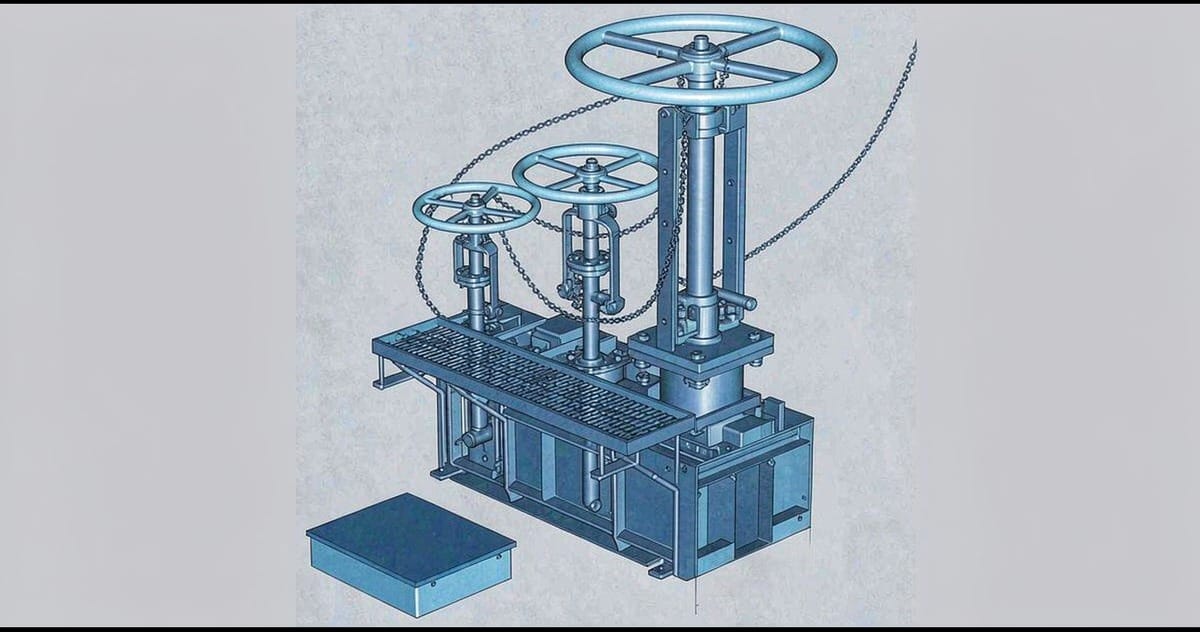
A chainwheel is a sprocket-type wheel clamped over the valve handwheel or fitted to a separate adaptor, with a continuous chain hanging to a workable height. The operator pulls the chain; torque goes through the sprocket to the handwheel. For elevated valves on tank farms, pipe racks, and plant structures, the chainwheel avoids permanent ladders and platforms that would otherwise be needed for a valve stroked rarely.
But chainwheels sit at the center of a long-running safety debate, and the debate deserves honest treatment. Occupational safety rules — including the guidance behind OSHA enforcement in the United States — draw a distinction between intermittent operation, where a chainwheel is generally acceptable, and repetitive or frequent operation, which pushes toward platforms, davits, or a powered actuator. Pulling hard on a hanging chain also introduces failure modes of its own:
- The operator standing below a high valve is under the chain, the wheel, and anything the valve discharges if a fitting fails.
- A slipping chain can cause a fall if the operator is off balance, and overenthusiastic pulling on a stuck valve loads the stem in bending as well as torsion.
- Long hanging chains whip under sudden release — which happens when a seized valve suddenly breaks free.
The professional answer is not to abandon chainwheels but to bound their use: chainwheels for intermittent operation of accessible-height valves, with a documented policy for frequent-operation positions, and guarding wherever people work below or pass under.
Guards and Interlocks on Chainwheel Installations
An unguarded chainwheel invites exactly the wrong kind of help — anyone can pull the chain. Where the valve position matters to process safety, guarding does double duty:
- A guard over the chainwheel with a lockable cover prevents unauthorized or accidental operation while leaving the chain reachable for authorized use.
- A chain lock-off device secures the chain itself against tampering.
- Where the valve sits above walkways, a lower chain guide keeps the chain from swinging into traffic and prevents snags on passing loads.
Guard design should be checked against the same access-height limits that justified the chainwheel in the first place: a guard that requires standing on a ladder to unlock has merely moved the hazard.
Extension Stems: From Floor Level to Stem Height
The buried and below-grade twin of the chainwheel is the extension stem — a shaft, usually square or otherwise keyed, coupled to the valve stem at the bottom and terminating at a handwheel, tee handle, or gearbox input at grade. Foundations, drainage valve chambers, and road crossings all depend on them.
The engineering issues are straightforward but frequently botched in the field:
- Alignment. The extension shaft must be collinear with the valve stem. Every degree of misalignment converts rotary input into side thrust on the stem, which binds packing, accelerates wear, and eventually bends stems. Where perfect alignment is impossible in a trench, a bevel gearbox at the bottom of the extension accepts the angular change and turns the problem into a solved one.
- Support. Long extension shafts need intermediate guide bearings or steadier bushes at spacing that keeps them straight under their own weight and under operating torque. An unsupported shaft in a deep chamber will whip and walk in its guides.
- Coupling security. The coupling to the valve stem must transmit torque without ratcheting or backing off; split couplings with set screws, pinned couplings, or keyed square drives are the reliable answers. A slipping coupling means the operator turns and turns and the valve does not move — and everyone downstream of a partial closure knows what happens next.
- Thrust handling. The handwheel at the top must be mounted on a bracket or topworks that takes thrust and reaction without loading the valve bonnet; hanging an extension off a small valve bonnet is a common shortcut with predictable results.
Buried Installations: Designing for Hostility
Below-grade valve operation is an environment problem as much as a mechanical one. Specification should cover:
- Submersible or high-ingress-protection topworks and gearboxes, because chambers flood and condensation is permanent.
- Corrosion-matched materials along the whole extension — a stainless shaft in a cast housing with plain-steel fasteners corrodes exactly at the fasteners.
- Spindle enclosures or sleeves that keep soil and backfill away from the working surfaces while allowing inspection.
- A clear, legible indication of valve position at grade — an arrow pointer or indicator plate visible from standing height — because an operator working a buried valve cannot see the valve at all.
Position indication on buried valves deserves emphasis. With an extension stem, the handwheel position is the only evidence of valve travel; a bracket that allows the handwheel to shift, or an indicator that drifts, will eventually cause someone to close a valve that was already closed, loading the stem against the stop.
Position Keeping and Indicator Discipline
Whether the operator is a chain, an extension shaft, or a bare handwheel on a standpipe, two disciplines apply:
- The position indicator must be driven from the valve stem or a positive gearbox connection — never from the accessory's own rotation, which can slip or rotate freely if a coupling fails.
- Travel stops belong at the valve or gearbox, not improvised at the topworks, so that overtravel protection survives the accessory.
Maintenance Access: Design the Second Visit
Most elevated and buried accessories are installed once and visited rarely, which is exactly why the visit should be designed for. Grease fittings reachable from grade, coupling inspection points that do not require excavation, and chamber layouts that allow a wrench to swing all decide whether the installation is maintained or merely tolerated. The cheapest time to fix access is before the concrete pours.
Common Installation Errors
The failures repeat across every plant:
- Extension stems installed without checking alignment, binding the valve packing until the valve becomes unoperable.
- Missing guide bearings on long shafts, allowing whip and progressive coupling wear.
- Chainwheels specified for frequent operation of critical valves, with no platform and no interlock.
- Unguarded chainwheels over walkways.
- Indicators driven from the accessory rather than the valve.
- Ordinary protection-class gearboxes buried below grade, corroding through within a few seasons.
An experienced manufacturer that produces the full valve range in-house — ball valves, control valves, gate valves, globe valves, check valves, strainers, knife gate valves, plug valves and butterfly valves — can support this review with chainwheel and guard options, extension-stem design support, and submersible-rated topworks for below-grade duties. Send your Valve Schedule or the key parameters for each position to the manufacturer's applications team for a per-line proposal.