Cast vs Forged Valve Bodies: Manufacturing Routes and
Cast and forged valve bodies differ in density, defect risk, NDT requirements, size and pressure suitability, cost, and lead time. How to specify the right route.
Cast vs Forged Valve Bodies: Manufacturing Routes and When Each Wins
Almost every industrial valve body starts as either a casting or a forging, and the choice between the two routes shapes the valve's pressure capability, its inspection burden, its price, and its delivery time. Neither route is "better" in the abstract. Casting wins on geometry freedom and cost at size; forging wins on metal integrity and strength at pressure. Understanding where each route wins — and why — is what turns a generic purchase specification into a defensible one.
The Two Manufacturing Routes
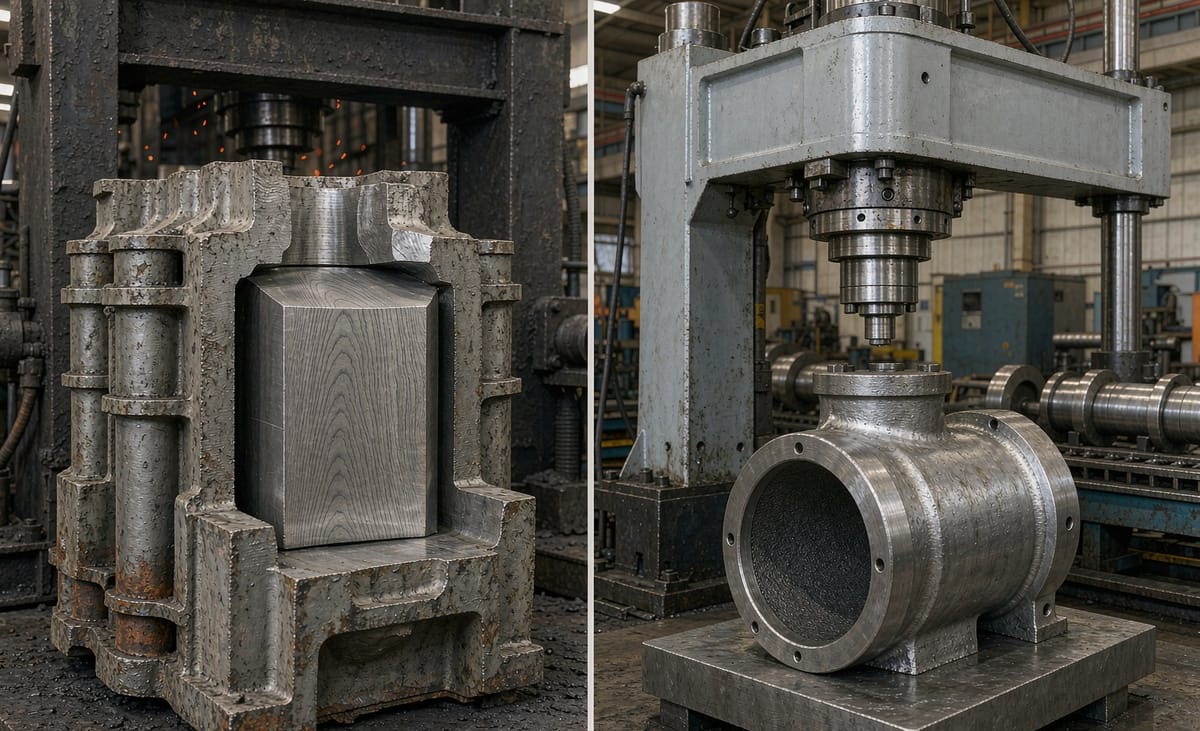
A cast body is produced by pouring molten metal into a mold shaped like the finished part. Sand casting is the workhorse for valve bodies: a pattern, a sand mold, a pour, shakeout, fettling, heat treatment, and machining. The process can reproduce nearly any internal geometry — complex flow passages, thick hub sections blending into thin walls — at a cost per part that falls gently with size.
A forged body is produced by hot-working a solid billet. The metal is heated and pressed or hammered into shape, usually in several operations, with significant machining afterward to reach the final form. Because forging mechanically works the material, it refines the grain structure, closes internal porosity, and produces a dense, homogeneous part. The geometry, however, is limited to shapes the metal can be pushed into: forged bodies are essentially machined from a worked blank, which is why they appear almost exclusively in relatively simple, compact forms — small through-conduit and ball valve bodies, needle valves, high-pressure gate and globe bodies.
Defect Risk and What It Means
Casting has an inherent characteristic that buyers must plan around: the solidification process can leave discontinuities.
- Gas porosity — dissolved gases released during solidification leave scattered voids.
- Shrinkage — the metal contracts as it freezes; poorly fed heavy sections can develop internal shrink cavities.
- Inclusions — sand, slag, or refractory debris entrapped in the metal.
None of these are inevitable, and a competent foundry with a sound feeding design, good melting practice, and disciplined process control produces castings that pass radiography routinely. But the risk is statistical, which is why pressure-boundary castings carry mandatory non-destructive testing.
Forged material does not have this problem class. Hot working closes any pre-existing porosity in the billet and refines inclusions into dispersed, harmless form. Ultrasonic testing of forgings is looking for anomalies that are rare, rather than screening for defects that are process-inherent. This difference in defect population is the technical heart of the cast-versus-forged decision.
NDT Requirements: Not Equal, and That Is Normal
Because cast pressure boundaries are screened for inherent defects, the inspection regime is heavier and formally staged. Depending on the class and the applicable standard, casting examination can include radiography of critical sections (or the relevant cast quality factors), surface penetrant or magnetic particle testing of machined areas, and ultrasonic testing of heavy sections. Acceptance levels are graded — the same casting standard defines severity levels, and the buyer specifies the level the design needs. Higher severity acceptance means more rejections, more repairs, and higher cost.
Forged bodies typically receive ultrasonic examination for internal soundness and surface examination of machined regions, with acceptance criteria that are straightforward to meet on sound wrought material. The result is less inspection-driven scrap and a shorter, more predictable quality loop.
Buyers should not read this as "castings are unreliable." It means the casting route carries a quality regime that must be budgeted — in cost and in time — and that the governing standards already account for it through design allowances.
Size and Pressure: Where Each Route Wins
The split is intuitive once you think in terms of metal volume and section thickness.
- Small bore, high pressure → forged. A forged body in compact carbon or stainless steel, often with welded ends, is the standard answer for small-diameter, high-pressure duties — instrumentation lines, injection points, high-pressure process branches. The small size means the casting cost advantage never materializes, while the forging delivers maximum metal integrity for the pressure carried. Forged steel gate, globe, and check valves in the small-to-mid bore range exist precisely for this territory.
- Large bore → cast. A body the size of a barrel cannot be forged economically; the billet, the press capacity, and the machining volume make it impractical, and large castings are produced in quantity worldwide with mature quality systems. Large gate, globe, check, and butterfly bodies are cast, full stop.
- The middle ground is where both routes are technically available and the decision is economic and scheduling-driven — though even here, severe duties (high pressure class, aggressive media, fatigue loading) tend to tilt the choice toward forging or toward castings with tightened NDT acceptance.
There is also the temperature and media dimension: highly corrosive or stress-corrosion-prone services favor material cleanliness, which favors forged or premium cast routes with controlled chemistry and heat treatment.
Weld Repair Rules
Castings can be weld-repaired, and the rules matter to buyers. Repair of pressure-boundary areas is permitted by the governing standards subject to: approval by the manufacturer's authorized inspection, the use of qualified weld procedures and welders, radiographic examination of the completed repair for significant repairs, and re-heat-treatment where required. Major repairs — those exceeding defined limits of depth or extent — carry documentation requirements. A repair map and report should be available on request.
What buyers should insist on is transparency: repairs are normal and acceptable when executed under the rules, but undisclosed or undocumented repair of critical areas is not. Forging, by contrast, rarely involves weld repair; a defective forging is usually scrapped, which is part of why forged deliveries can be less predictable in scheduling when material issues arise at the forge.
Cost and Lead Time
The economics differ structurally:
- Casting carries tooling cost (patterns, cores) amortized over quantity, moderate material cost, and machining limited to sealing surfaces and hubs. Per-unit cost falls sharply with repeat orders. Lead time is dominated by mold making, casting, heat treatment, and NDT — with NDT-triggered repairs the main schedule risk.
- Forging carries high per-unit material and machining cost because much of the billet becomes chips, but no mold amortization and minimal NDT rework. For small parts, machining time dominates; for standard forged valve ranges, stock bodies make delivery fast.
The practical consequence: for a standard small-bore forged valve from an established range, delivery is often quicker than a made-to-order large casting, while a repeat order of a proven casting is fast and cheap. One-off special castings are the slowest and most expensive corner of the market.
How to Specify
A defensible specification answers a short list of questions:
- Is the duty high pressure or fatigue-prone at small bore? Lean forged.
- Is the body large or geometrically complex? Cast, with NDT level matched to severity.
- What casting quality class does the design actually need? Over-specifying severity levels buys cost and schedule risk without adding safety.
- What documentation is required — chemistry, mechanicals, heat treatment charts, NDT reports, repair maps?
- Are weld repair procedures and limits defined in the purchase documents?
When the schedule contains a mix of small-bore forged and large-bore cast bodies across the same project, it is efficient to review the whole valve schedule with the manufacturer's applications team — an experienced industrial valve maker that produces the full range in-house: ball, control, gate, globe, check, strainer, knife gate, plug, and butterfly valves — so the cast and forged positions are qualified consistently, with material certificates, NDT acceptance levels, and repair rules stated per line, and a per-line proposal returned on that basis.



