Bellows-Sealed Valves: Hermetic Stem Sealing for
How metal bellows stem sealing works, when it beats packing on fugitive emissions and zero-leak duties, and what to check on cycle life, backup packing, and failure detection.
Bellows-Sealed Valves: Hermetic Stem Sealing for Demanding Service
Packed gland seals do one thing imperfectly: they leak. Slightly, by design, and continuously — enough lubrication film to let the stem move without scoring, and enough of a leakage path to matter enormously when the medium is toxic, flammable, radioactive, ultra-pure, or simply expensive. Bellows-sealed valves were developed to eliminate that path entirely. Instead of a dynamic seal that must slide against the stem, a welded metal bellows forms a static, hermetic barrier between the process and the atmosphere. There is nothing to lubricate, nothing to tighten, and — in normal operation — nothing that escapes.
This article explains how the bellows does its job, where the technology justifies its premium, and what to check before specifying it.
The Sealing Principle
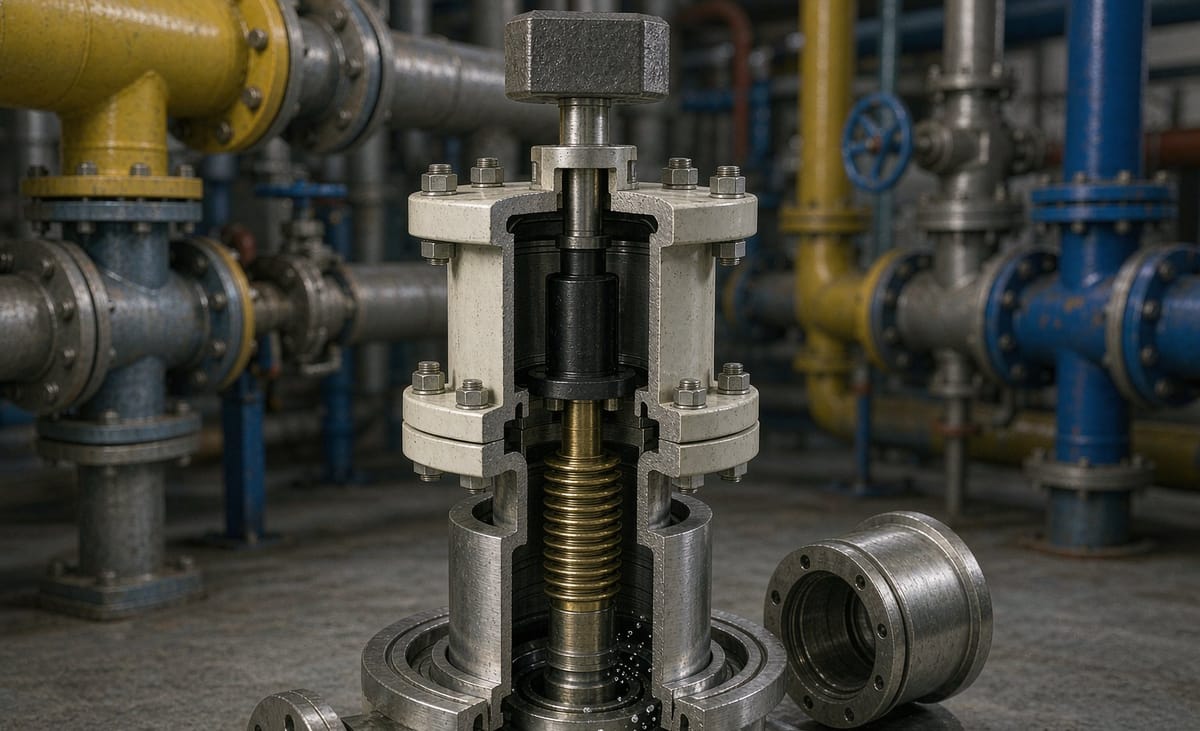
A bellows is a thin-walled cylindrical element with convolutions that flex axially. In a bellows-sealed valve, one end of the bellows is welded to the bonnet or body and the other to the stem or a stem plate. When the stem travels to open or close the valve, the convolutions extend and compress. The process-to-atmosphere boundary is then a fusion weld, not a rubbing interface. Two boundaries exist — the welds at each end of the bellows and the welds of the body and bonnet joints — and none of them move.
The consequences are significant:
- Zero fugitive emission from the stem in normal service. The seal does not depend on a controlled leakage film, so there is no detectable emission to measure at the gland.
- No dynamic friction. Operating torque stays smooth and predictable over the valve's life, which helps automation and reduces stem wear.
- Hermetic performance in both directions. The bellows blocks ingress as well as egress, which is why the technology is standard on vacuum systems and on ultra-pure gas panels where atmospheric contamination must stay out.
Bellows Materials and Manufacturing
Most industrial bellows are made from austenitic stainless steel, with higher-alloy and nickel-alloy materials used where chlorides, acids, or elevated temperatures attack the standard grades. The material must combine corrosion resistance with high cycle fatigue strength, and the thin walls — often a fraction of a millimetre — make that balance delicate.
Two manufacturing routes dominate:
- Hydroforming. A tube is expanded into convolutions under internal pressure. Hydroformed bellows generally have longer convolutions and wall thickness suited to higher pressure ratings and longer travel.
- Welded (edge-welded) construction. Annular discs of formed profile are welded at their inner and outer edges, producing a bellows with more convolutions in the same installed length and excellent stroke-to-length efficiency. Edge-welded bellows are common on high-cycle duties and smaller-bore valves.
The choice affects cycle life, installed length, and pressure capability. For a given valve, the specifier's job is to confirm that the offered bellows is rated for full stem travel at the design pressure and temperature, not just for the nominal rating.
Comparing Bellows with Packed Glands
Packing is not a bad technology; it is a different one. A properly maintained gland is serviceable, cheap, and replaceable in line. But it is fundamentally a controlled-leak device, and its performance decays with every stroke as packing consolidates and the stem wears its micro-finish.
- Packing requires periodic adjustment and eventual replacement; a bellows requires none between cycle limits.
- Packing leaks a small amount continuously; a bellows leaks nothing until it fails.
- Packing tolerates occasional over-stroking and abuse; bellows life is consumed by cycles and travel, so excessive overtravel or rapid cycling shortens it.
- Bellows valves cost more upfront — the bellows assembly and the longer bonnet it needs are the bulk of the difference — and the assembly is a pressure-retaining part that must be replaced, not adjusted, at end of life.
The crossover logic is straightforward: the more severe the consequence of a leak, the faster the bellows premium pays for itself.
Where Bellows Sealing Is the Right Answer
Certain services have effectively settled the argument in favor of bellows:
- Toxic and lethal media. Where a leak is a personnel hazard rather than a housekeeping issue, hermetic sealing is the baseline requirement, and double-walled bellows designs are available for the most severe cases.
- Flammable and hazardous hydrocarbons. Fugitive-emission regulations push gland leakage limits ever lower; a bellows removes the stem from the compliance problem altogether.
- High-purity and specialty gas. Semiconductor gas cabinets, analytical sampling, and oxygen service value a seal that neither leaks out process gas nor admits air and moisture.
- Vacuum systems. A packing gland is a virtual leak path into vacuum; a bellows is not.
- Nuclear and radiological service. Containment integrity at the stem is non-negotiable.
- Vacuum-jacketed and cryogenic lines, where the bellows maintains the annulus integrity.
Cycle Life, Travel, and Design Margins
Bellows life is quantified in full-stroke cycles at rated conditions, and reputable manufacturers publish cycle-life data validated by testing. Three design levers determine how that number translates into field performance:
- Travel per convolution. Compressing each convolution over a small fraction of its capability multiplies fatigue life. Valves with generous bellows length relative to stroke outlast tightly packaged designs.
- Operating position. A bellows lives in the middle of its travel range; specifying the valve so the closed position sits near mid-stroke rather than at full compression preserves margin.
- Cycle frequency. A control duty cycling every few minutes consumes bellows life far faster than an isolation valve that moves monthly. High-cycle duties may justify a different valve family altogether.
Backup Packing: The Second Barrier
Nearly every industrial bellows-sealed valve carries secondary packing above the bellows. Its purpose is containment, not primary sealing — if the bellows or a weld fails, the packing catches the leak and gives the plant time to isolate and replace the valve in a controlled way. The specifier should confirm that the backup packing is genuinely functional, with a lubricated or graphite-based set, a working gland follower, and — on severe service — a leak-detection connection between bellows and packing that can be monitored. A backup seal that exists only on the drawing is a risk disguised as redundancy.
Failure Modes and Detection
Bellows failures are rarely mysterious. The dominant modes are fatigue cracking from excessive travel or vibration, corrosion attack on the thin wall, and mechanical damage during installation. Detection is simple in principle: the inter-annulus monitoring port on valves so equipped will show pressure or detectable leakage, and any gland leakage on a bellows valve means the bellows is compromised — the backup packing is doing exactly what it was designed for. That is the moment to schedule replacement, not to tighten the gland and forget it.
Cost, Selection, and Justification
A bellows-sealed valve typically commands a substantial premium over a packed equivalent in the same size and material. The justification is not universal; it is duty-specific. Run the comparison where it belongs — on consequence of leakage, regulatory exposure, media cost, and maintenance access — and the premium is easy to defend for the services listed above and easy to avoid where ordinary packing is entirely adequate.
An experienced manufacturer that produces the full valve range in-house — ball valves, control valves, gate valves, globe valves, check valves, strainers, knife gate valves, plug valves and butterfly valves — can support this evaluation with cycle-life test data, bellows material certifications, and weld procedure records. Send your Valve Schedule or the key parameters for each position to the manufacturer's applications team for a per-line proposal.