Ball Valve Port Options: Full Bore, Reduced Bore, and
How full bore, reduced bore, and venturi ball valve ports differ in flow capacity, pigging compatibility, weight, and cost — and how to choose the right port for each line.
Ball Valve Port Options: Full Bore, Reduced Bore, and Venturi
Ask a valve engineer to summarize the single most consequential decision on a ball valve specification, and the answer is rarely trim material or actuator sizing. It is the port. Whether the ball carries a bore equal to the line bore, something noticeably smaller, or a shaped venturi restriction determines flow capacity, pigging compatibility, weight, cost, and — indirectly — how much energy the pumping system burns for the life of the plant. Yet port selection is still frequently made by habit or by copying the previous project's datasheet, which is how undersized pigging passages and oversized, overweight valves end up installed on lines that never needed either.
This article sets out how the three main port options differ, where each one earns its place, and the selection errors that show up most often in project reviews.
What "Port" Actually Means on a Ball Valve
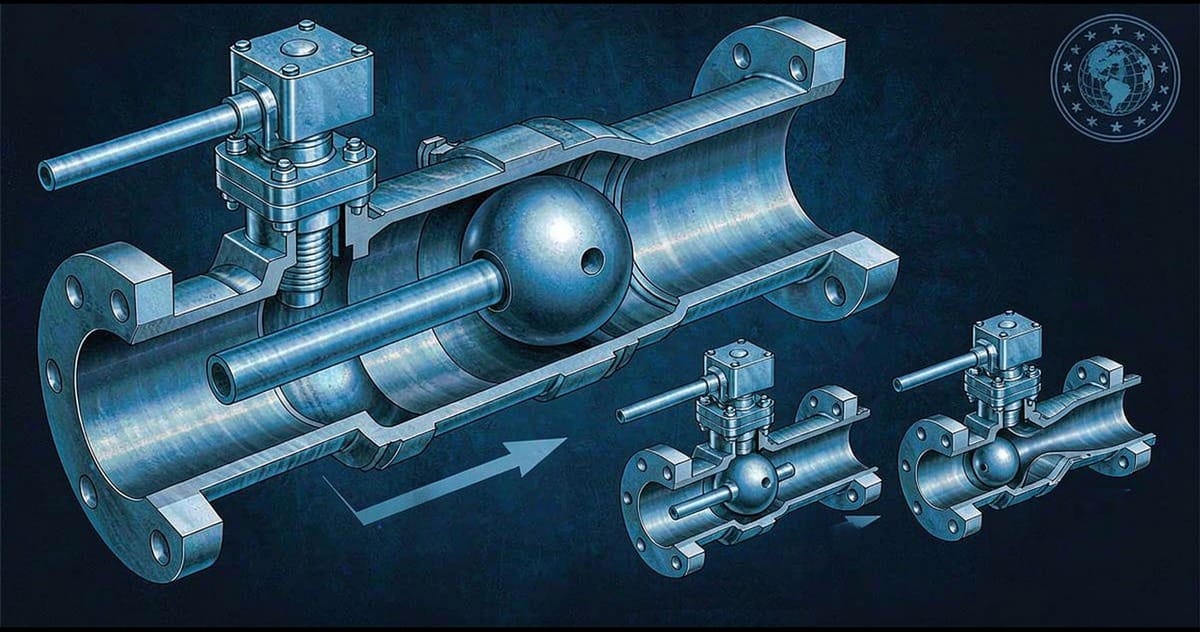
The port is the circular passage through the ball. In the open position, flow passes through this bore and across two seat surfaces. Three broad configurations exist:
- Full bore (full port): the bore diameter matches the nominal pipe bore, so the valve presents essentially no restriction to the flow. A pig or cleaning tool can pass straight through.
- Reduced bore (reduced port): the bore is typically one pipe size or more below nominal. Flow is constricted at the ball and expands again downstream.
- Venturi port: a reduced bore with a tapered, streamlined transition on both sides of the ball, shaped to recover pressure more gradually than an abrupt step. The restriction still exists, but the losses around it are lower.
The distinction matters because a ball valve is not a linear-throttling device. It is an on-off or coarse-modulating component, and its port determines how "invisible" the valve is to the flowing stream when open.
Full Bore: Maximum Passage, Maximum Compatibility
Full bore valves are the default choice wherever the line must behave as continuous pipe. The advantages are concrete, not cosmetic:
- Piggability. Pipeline service, batching operations, and lines cleaned with foam or mechanical pigs require an unobstructed bore of consistent diameter. Even a slightly reduced port can shear a pig cup or stop the tool mid-run. Standards for pipeline valves assume full-open bore for this reason, and any deviation is treated as an engineered exception.
- Metering accuracy. Upstream of custody-transfer or fiscal metering runs, flow conditioners and straight-length requirements are calculated for unobstructed pipe. A reduced-bore valve adds a disturbance the meter station designer never budgeted for.
- Minimum permanent pressure drop. With the bore equal to the pipe, the open valve contributes almost nothing to system head loss beyond seat and cavity turbulence.
- Draining and flushing. Full-bore valves drain lines completely and allow high-velocity flushing passes that sweep solids effectively.
The price is size. The ball, body, and flanges must accommodate a bore equal to the pipe, so a full-bore valve in a larger line class can be substantially heavier and more expensive than its reduced-bore equivalent. For big-diameter, high-class lines, that difference is not marginal — it drives crane selection, structural loading, and cost.
Reduced Bore: The Workhorse That Is Often Right
Reduced bore valves exist because most process lines do not need a through passage. Where the medium is clean or filtered, where pigging will never occur, and where the line was hydraulically designed with the valve's restriction already in mind, a reduced port delivers the shutoff and sealing character of a ball valve at lower weight, lower torque, and lower cost. Smaller balls need less seat area, lower operating torque, and correspondingly smaller gearboxes or actuators — savings that compound across a plant with hundreds of valves.
The legitimate use cases are familiar:
- Instrument and utility headers where flow capacity is far below line capability.
- Isolation around equipment — pumps, exchangers, filters — where the equipment itself is the governing pressure drop.
- Clean liquid and gas distribution where the media carry no solids and no cleaning tool will ever run.
- Skid-mounted packages where footprint and weight dominate.
The discipline required is simple but often missing: the hydraulic calculation must include the reduced bore's resistance. A reduced-bore valve dropped into a line sized for full flow can turn a marginal circuit into a capacity bottleneck, or in slurry and solids-laden service, create a low-velocity pocket where particles settle and erode the ball and seats.
Venturi Port: Engineered Compromise
Venturi-port balls sit between the two. The bore is reduced, but the entry and exit are tapered so the flow accelerates and decelerates gradually. Compared with a plain reduced bore of the same minimum diameter, a venturi profile reduces turbulence and permanent pressure loss, and it is gentler on soft seats in high-velocity gas service. In trunnion-mounted valves for larger lines, venturi trimming is a standard way to cut ball mass and torque without taking the full hydraulic penalty of an abrupt step.
Where the specification allows a moderate, well-characterized restriction — gas transmission laterals that are pigged rarely or not at all, high-pressure isolation where every kilogram of ball and body counts — the venturi option often delivers the best cost-to-capacity ratio. It deserves explicit mention on the datasheet, though. A venturi port typed generically as "reduced" invites the wrong assumptions during hydraulic review.
Pressure Drop and Energy: Why the Open-Valve Loss Matters
An open ball valve is usually promoted as offering negligible resistance, and a full-bore valve genuinely does. The permanent pressure loss across a reduced-bore valve, however, scales with the square of velocity through the restriction, and it is permanent — paid every operating hour, not just during stroking. For continuous, high-throughput service — compressor recycle lines, main transfer headers, boiler feed schemes — a restriction that looked trivial in the datasheet can represent measurable pumping or compression energy over a year. The correct comparison is not "which valve is cheaper" but "which valve is cheaper over the life of the duty," with energy and maintenance on one side of the ledger and purchase price and weight on the other. In intermittent or low-flow service, that equation usually favors reduced bore; in continuous main-line duty, it frequently does not.
Common Selection Errors
The same handful of mistakes recur in port selection:
- Defaulting to full bore "for safety." Over-specifying the port inflates weight, torque, actuator size, and cost on every line, including the dozens where the restriction was irrelevant. The safest specification is a deliberate one, not a blanket one.
- Defaulting to reduced bore without checking pigging plans. Operators add pigging programs years after commissioning. A line full of reduced-bore valves cannot be retrofitted cheaply.
- Forgetting the metering interface. Reduced-bore valves adjacent to flow meters distort the velocity profile the meter assumes.
- Ignoring solids and settling. A restriction in slurry or wax-laden crude creates deposition points that erode seats and eventually seize the ball.
- Leaving the port off the datasheet. When the purchaser's data sheet is silent, the manufacturer's standard — which may be reduced bore in many sizes — fills the gap, and the discrepancy surfaces only at hydraulic review or, worse, at pigging trials.
Closing the Specification
Port selection should be settled line by line, against three questions: does anything need to pass through the bore, does the hydraulic budget tolerate the restriction, and what does the weight and cost difference buy? Answering those with the piping and process discipline in the room takes minutes; discovering the answer wrong at site takes weeks.
An experienced manufacturer that produces the full valve range in-house — ball valves, control valves, gate valves, globe valves, check valves, strainers, knife gate valves, plug valves and butterfly valves — can support this review with bore dimensions, flow coefficients, torque data, and pigging-compatibility records for each series. Send your Valve Schedule or the key parameters for each position to the manufacturer's applications team for a per-line proposal.