ATEX and IECEx: Valve Actuators for Hazardous Areas
A practical guide to ATEX and IECEx certification for valve actuators — zones, Ex protection types, temperature classes, documentation, and the specification mistakes that cause compliance failures.
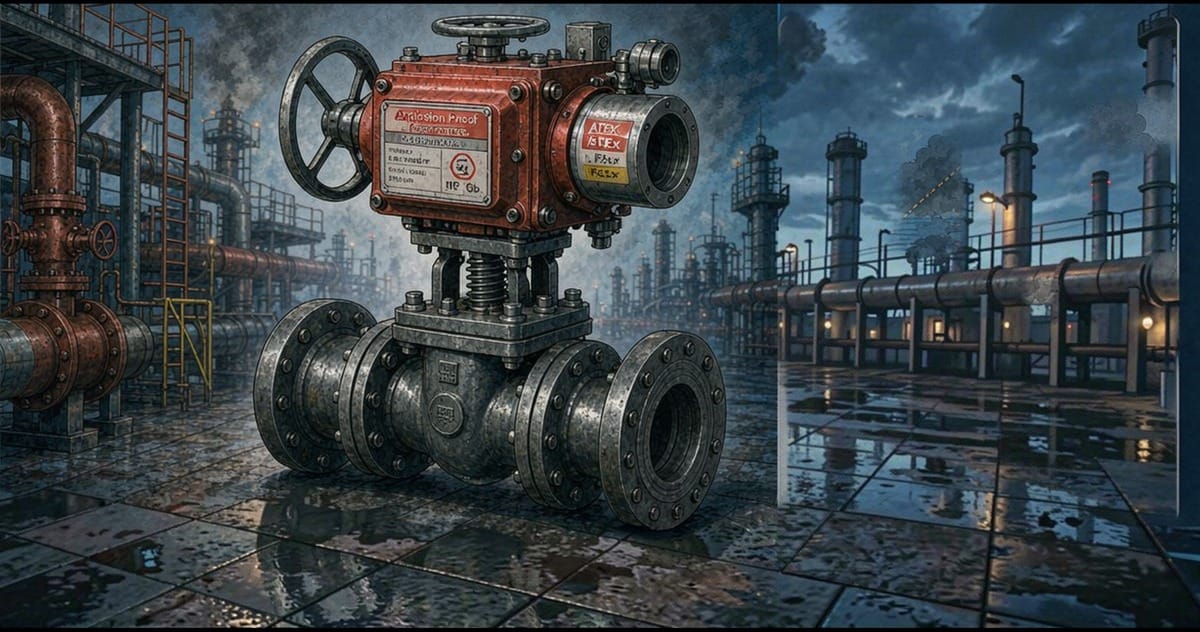
ATEX and IECEx: Valve Actuators for Hazardous Areas
A valve in a hazardous area is more than a pressure boundary: everything attached to it — the electric actuator, the solenoid valve, the limit switch box, the positioner — is an electrical device sitting in an atmosphere where a spark or a hot surface can cause an explosion. Certification frameworks exist precisely for that reason, and the two that dominate international procurement are ATEX, the European directive-based system, and IECEx, the international certification scheme. Yet actuators remain one of the most frequently mis-specified items on valve packages, usually because purchasers treat the Ex certificate as a stamp rather than as a set of engineering constraints. This article walks through the system as it applies to valve automation.
Zones: Where the Gas Actually Is
Both frameworks start with area classification — dividing the plant into zones according to how often and how long an explosive atmosphere is present. For gases and vapors:
- Zone 0 — explosive atmosphere present continuously or for long periods, typically inside tanks and vessels.
- Zone 1 — explosive atmosphere likely to occur in normal operation, such as around vents and loading points.
- Zone 2 — explosive atmosphere unlikely in normal operation and, if it occurs, only for short periods; most outdoor valve locations on well-run plants fall here.
For combustible dust, the parallel zones are Zone 20 (continuous), Zone 21 (occasional in normal operation), and Zone 22 (unlikely, short duration). The zone determines the minimum equipment category and acceptable protection types, and it is fixed by the plant's area classification study — not by the equipment maker. This is the first and most common specification failure: asking for "an Ex certified actuator" without stating the zone.
Equipment Categories and EPL
Within ATEX, equipment is grouped into categories that map to zones. Category 1 equipment is suitable for Zone 0, Category 2 for Zone 1, Category 3 for Zone 2; the IECEx system expresses the same idea as the Equipment Protection Level, EPL Ga, Gb, and Gc for gas atmospheres (Da, Db, Dc for dust). A valve actuator carrying Category 2 / EPL Gb marking may be installed in Zone 1 or Zone 2; it may not go into Zone 0. Over-rating is legal but expensive; under-rating is a compliance violation. Note that for Zone 0 applications, the practical approach for valve automation is usually to keep the electrical accessories outside the Zone 0 volume or to use intrinsically safe circuits rated for the location.
Protection Types: What the Marking Means
The protection type is the engineering method by which the equipment prevents ignition. For valve actuators and accessories, four dominate:
- Ex d — flameproof enclosure. The enclosure is built to contain an internal explosion and quench the flame as it escapes through flame paths at joints and cable entries. Robust and tolerant of dirty plants, but heavy, and the enclosure must not be opened live. Common for electric actuators in Zone 1.
- Ex ia — intrinsic safety. The circuit energy is limited — voltage, current, and stored energy — so that a fault cannot release enough energy to ignite the atmosphere. Used heavily for instrument-level devices: limit switches, positioners, solenoid pilot circuits wired through IS barriers. The limiting happens in the associated apparatus (the barrier or isolator), so the certificate covers the loop, not just the device.
- Ex eb — increased safety. The equipment is designed with enhanced measures — generous creepage and clearance distances, temperature margins, robust terminations — so that no arcs or hot spots occur in normal operation. Typically applied to junction boxes, terminal enclosures, and some actuator components in Zone 1.
- Ex t — protection by enclosure, for dust. The dust-side counterpart: an enclosure that prevents dust ingress and controls surface temperature.
A single actuator often combines types — for example, a flameproof enclosure for the motor compartment with increased-safety terminals. The marking string on the nameplate tells you which parts carry which protection, and every element of that string must match the installed location.
Temperature Classes: Matching the Gas
Ignition can be caused by a hot surface as easily as by a spark. Both frameworks therefore classify equipment by maximum surface temperature, T1 through T6, against the auto-ignition temperature of the expected gases:
- T1 — surface up to 450 °C, suitable for gases like hydrogen and methane with high ignition temperatures.
- T2, T3, T4 — progressive steps down through 300 °C, 200 °C, and 135 °C, covering most hydrocarbons and common solvents.
- T5, T6 — 100 °C and 85 °C, needed for sensitive materials such as carbon disulfide and some ether compounds.
The rule: the actuator's temperature class must be at or below (numerically higher) the class required by the gas. For actuators, ambient temperature range matters too — an actuator sized for a desert install may exceed its rated surface temperature class at high ambient, which is why certificates state an ambient range alongside the class.
What Actually Gets Certified on a Valve Package
Valve automation multiplies the number of certified devices on a single valve:
- Electric actuators — the largest certified item, carrying motor, controls, and enclosure protections.
- Solenoid valves — certified either as flameproof/coil devices or wired intrinsically; the coil surface temperature is the critical parameter.
- Limit switch boxes and position transmitters — usually Ex ia or Ex d enclosures with certified contacts.
- Electropneumatic positioners — commonly Ex ia, sometimes Ex d.
Each device has its own certificate, and the installed assembly must keep the protections intact: cable glands must be certified for the enclosure type (a flameproof enclosure requires flameproof-rated glands with the correct entry thread), breather drains are generally not permitted on Ex d enclosures, and spare entry blanks must be of the certified type. Purchasers who buy a certified actuator and then fit an uncertified gland have, in the eyes of the law, de-certified the equipment.
Documentation: What to Ask For
Compliance is a paperwork chain, and the documents should be collected at order stage, not hunted for at commissioning:
- The EU Declaration of Conformity (for ATEX) naming the directive, the equipment category, and the notified body where applicable.
- The IECEx Certificate of Conformity listing the protection types, gas group, temperature class, ambient range, and specific conditions of use.
- The Instructions for Safe Use, which carry binding installation constraints — permitted cable gland types, entry thread sizes, earthing requirements, and any special conditions marked with an "X" on the certificate.
- For Ex ia loops, the barrier or associated apparatus parameters showing that the combined loop remains within the safe limits.
The "X" conditions deserve attention: many certificates carry specific conditions of use, and ignoring one — an ambient restriction, a mandatory gland type — voids the compliance even though the certificate exists.
The Most Common Errors
In practice, the failures cluster around a short list:
- Specifying the certificate but not the zone, so the category cannot be checked against the location.
- Ignoring the gas group distinction between Group I/II categories and the subdivision IIA, IIB, IIC — an IIB-certified device is not acceptable where the gas requires IIC, such as hydrogen or acetylene service.
- Buying flameproof actuators and installing standard glands, breather drains, or uncertified position feedback cables.
- Overlooking ambient temperature limits, particularly on actuators in hot climates or near steam lines, which can push the surface temperature above the declared class.
- Treating the dust zones as an afterthought — dust certifications (Group III, Ex t) are a separate assessment, and a gas-certified device is not automatically acceptable in Zone 21 or 22.
Specifying It Right
A clean actuator specification states the zone and EPL, the gas group and temperature class, the ambient temperature range, the required protection type per device (actuator, solenoid, switches, positioner), and the documentation set to be delivered. An experienced manufacturer that produces the full valve range in-house — ball valves, control valves, gate valves, globe valves, check valves, strainers, knife gate valves, plug valves and butterfly valves — can supply the automated valve package with matching Ex certificates and declarations for every accessory, checked line by line against the area classification. Send your Valve Schedule with the hazardous area data for each position to the manufacturer's applications team for a per-line proposal and a complete documentation pack.



