Face-to-Face Dimensions: ASME B16.10 and Why They Matter
Why ASME B16.10 face-to-face dimensions matter for valve interchangeability, spares and plant modifications — including API 6D lengths, API 609 and ISO 5752 butterfly valve series.
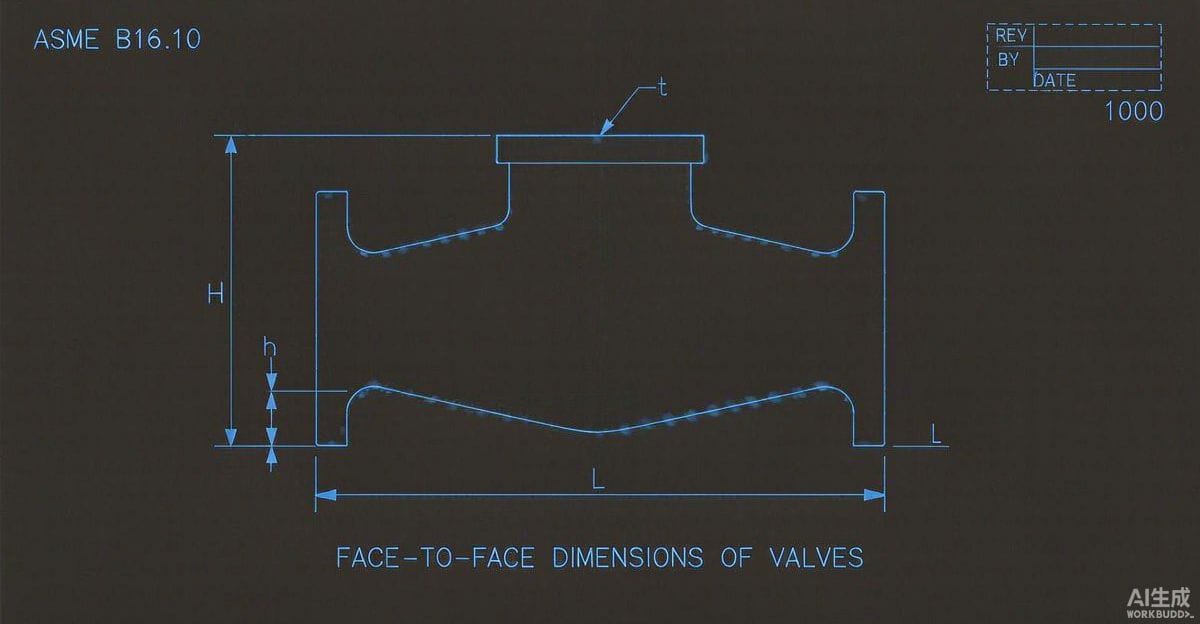
Face-to-Face Dimensions: ASME B16.10 and Why They Matter
Face-to-face (and end-to-end) length is the dimension that decides whether a replacement valve drops into an existing line — or turns a routine swap into a piping modification project. Yet it is the most commonly overlooked line on a datasheet, precisely because it looks routine. This article explains why face-to-face standardization exists, how ASME B16.10 and its related documents organize the lengths, and what to check before ordering a valve that must fit where another one came out.
Why Standardized Face-to-Face Matters
Piping is built to fit between fixed points: pipe spools are welded, flanges are spaced, supports are located, and valves sit in a gap that was cut for a particular overall length. Standardized face-to-face dimensions deliver:
- Interchangeability. Any compliant manufacturer's valve of a given size, class and standard can replace another without touching the pipe. This is what keeps a warehouse stock meaningful.
- Spares economy. Plants hold standard-length valves as spares because they know any like-for-like position can accept them.
- Modifications and expansions. When a unit is debottlenecked or a line re-routed, designers lay out piping on published dimension tables without waiting for manufacturer drawings.
- Open competition. If lengths were free to vary, every valve change would lock the buyer into one manufacturer's geometry. Standardization keeps bidding open.
None of this works if a nonstandard length sneaks into the order unnoticed.
ASME B16.10: The Core Length Standard
ASME B16.10 organizes valve lengths by valve type, nominal size, and pressure class. Within a given size and class, it publishes multiple series — commonly described as the long series and the short series — so that different construction philosophies can coexist:
- Long pattern gives the manufacturer more room for flow path, erosion allowance and bolted bonnet geometry; it was historically the default in heavy process service.
- Short pattern trims the length for economy of space, weight and cost, and is widely used where the piping layout rewards compactness. For some valve types the short pattern aligns with dimensions originally established by other standards families.
The essential discipline: the piping class must state the pattern (long or short, or the specific dimension) along with size and class, because the same valve type can differ substantially in overall length between patterns. A Class 150 gate valve and a Class 600 gate valve of the same nominal size in the same pattern are typically similar in length, but across patterns and valve types the differences can be dramatic — enough that substituting a short-pattern valve for a long-pattern position requires pipe spool changes.
API 6D: Pipeline End-to-End Lengths
Pipeline valves follow their own dimension regime. API 6D publishes end-to-end (for weld-end valves) and face-to-face (for flanged valves) dimensions that are, in a number of size and class combinations, longer than the ASME B16.10 equivalents. This is deliberate: pipeline valve bodies are built for full-bore pig passage, thick walls and DBB/DIB seat arrangements, all of which want space.
The consequence for mixed-duty plants: a pipeline block valve near the plant fence may sit on API 6D lengths while the valve ten meters downstream sits on B16.10. Piping designers keep the two families straight by specification; maintenance crews who order "the same valve" without checking the standard can receive a valve that is dimensionally close but not close enough.
Butterfly Valves: API 609 and ISO 5752
Butterfly valves are the extreme case of face-to-face variability, because their wafer and lug bodies sandwich between line flanges and the length is a thin face-to-face dimension with many published series:
- API 609 Category A covers wafer-type resilient (soft-seated) butterfly valves.
- API 609 Category B covers high-performance designs — single-offset and double-offset — in wafer and double-flange construction, typically metal or fire-safe seats.
- ISO 5752 (and its European sibling EN 558) publish a large family of face-to-face and face-to-center series, numbered rather than named, from very short rubber-lined dimensions through long series that match the overall lengths of gate valves.
The numbered series exist so that a butterfly valve can be made interchangeable with another valve type in the same line — a short series to replace another short butterfly, or a long series so a butterfly can drop into a gate valve's space. When replacing a butterfly valve, the series number matters more than the nominal standard: two valves both "compliant with ISO 5752" may belong to different series and be inches apart in length.
The Retrofit Problem: Short Series Where a Long Series Used to Be
Plants evolve. Decades ago a long-pattern valve was installed; today the standard offer is short pattern. Replacing it creates a gap in the line:
- Pipe spools must be extended, which means cutting, welding, radiography and often tying into adjacent supports.
- Flanged joints may be refitted with the old bolt holes rotating out of alignment — bolt-hole orientation is part of the fit problem, not just length.
- Wafer and lug butterfly valves are particularly vulnerable: a series change of even a modest amount leaves the valve unable to seal against the flange faces.
The practical mitigation is the spacer: a ring spacer welded or bolted into the line to make up the length difference, which keeps the modification local. Spacers are routine but cost shop time and introduce new welds into a system that may not welcome them — hydrocarbons service especially. The cheapest fix is always ordering the correct length the first time.
The Cost of Nonstandard Face-to-Face
Sometimes a nonstandard length is unavoidable — compressor skids, OEM packages and brownfield tie-ins all produce them. Understand what you are buying:
- Nonstandard lengths are typically engineered-to-order: special patterns, castings or fabrications, longer lead times, and single-source dependence for future spares.
- The price premium is not just machining — it is the loss of interchangeability for the life of that position.
- Where a nonstandard length is truly required, specify it as a clear deviation with a drawing, not as an afterthought on the datasheet.
Checking Face-to-Face Before You Order a Replacement
A short checklist that prevents most retrofit surprises:
- Identify the governing standard and pattern of the existing valve (B16.10 long or short; API 6D; API 609 Category; ISO 5752 series number).
- Measure the actual installed length, not just the nameplate — prior generations and repairs may have deviated.
- Confirm the end connections (flange rating and facing, weld-end preparation) along with the length; they fail together.
- Check bolt-hole orientation for flanged replacements.
- For wafer and lug valves, confirm the seat-to-flange face sealing geometry matches the mating flanges.
- Ask the manufacturer to confirm the length in the order acknowledgment, in writing.
Confirming Fit with Manufacturer Support
Face-to-face mismatches are cheap to prevent and expensive to discover at installation. An experienced manufacturer that produces the full valve range in-house — ball valves, control valves, gate valves, globe valves, check valves, strainers, knife gate valves, plug valves and butterfly valves — can verify the governing standard and series for each replacement position, flag pattern mismatches before fabrication, and quote correct special lengths where the line genuinely needs them. Send the valve schedule or the key parameters for each position to the manufacturer's applications team for a per-line proposal.



