API 600, API 602, and API 603: Gate Valve Standards
A practical comparison of API 600, API 602 and API 603 gate valve standards — scope, wall thickness, trim numbering, end connections, testing and how to pick the right one for procurement.
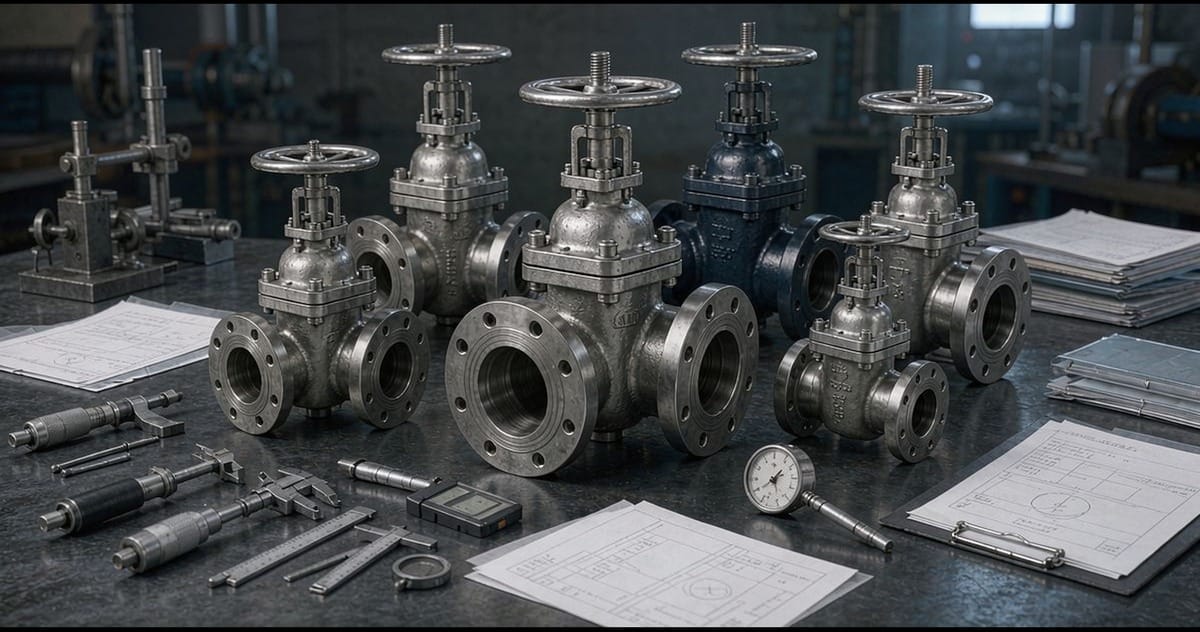
API 600, API 602, and API 603: Gate Valve Standards Explained
Ask for a "gate valve" in a refinery or petrochemical plant and the quotation that comes back will cite one of several codes: API 600, API 602, or API 603. They are all gate valve standards, they are all widely referenced in piping specifications, yet they describe distinctly different products. Confusing them leads to mismatched wall thicknesses, wrong pressure ratings, valves that do not fit the line, and rework during commissioning. This article walks through what each standard covers, where they overlap, and how to map them to real purchase lines.
Why These Standards Exist
Gate valves are the workhorse isolation valve in hydrocarbon service: full-bore, bidirectional, low pressure drop, and reasonably fire-safe by construction. But a gate valve for a large-diameter crude line at Class 150 bears little resemblance to a forged instrument-isolation valve at the edge of a reactor. The API suite splits the market by construction type and service ambition instead of pretending that a single document can govern them all.
- API 600 — bolted-bonnet steel gate valves for petroleum, petrochemical and related severe service, normally cast construction, in the larger pressure classes.
- API 602 — compact forged-steel gate valves, typically in small pipe sizes, where the line is small but the pressures can still be punishing.
- API 603 — corrosion-resistant cast gate valves (the austenitic and alloy families), covering Class 150 through Class 600 in flanged, wafer-style ends where lighter walls are acceptable.
The split is not arbitrary. Each standard carries its own minimum wall thickness rules, pressure-area rationale, trim requirements, and testing regime, tuned to the construction method and the duty the valve is expected to see.
API 600: The Refining Workhorse
API 600 covers bolted-bonnet steel gate valves — carbon, low-alloy, stainless and other alloy steels — for refinery and petrochemical service. It is the document most process piping specifications reach for when they list a gate valve in Class 150 through Class 2500.
Several features define the API 600 valve:
- Heavier wall. Minimum wall thicknesses in API 600 are more generous than those required by ASME B16.34 for the same pressure class. The standard accepts a corrosion allowance philosophy that suits sour and erosive service.
- Bolted bonnet. The design is explicitly bolted-gasket bonnet, which preserves maintainability — the bonnet can be removed, gasket replaced, and the valve returned to service.
- OS&Y and backseat. Outside screw and yoke construction with a backseat is the norm. Rising stem gives visual position indication; the backseat supports stem packing replacement under pressure.
- Trim numbering. The familiar trim designation system — trim 1 through trim 16 — comes straight from API 600's tables. Each trim number fixes the material of the seat, wedge/disc, stem, backseat and stem packing. A spec line reading "gate valve, Class 300, trim 8" tells the manufacturer exactly which combination to build without further negotiation.
- Flex wedge preference. Flexible wedge or split wedge designs dominate for larger sizes and higher classes to accommodate seat distortion and thermal binding.
Typical applications: hot oil, crude, furnace transfer lines, steam headers — anywhere the plant wants a robust, repairable, tight-closing block valve with a long service life.
API 602: Compact, Forged, High-Pressure
API 602 governs compact forged gate (and globe and check) valves, the small-bore workhorses found around instrumentation, chemical injection points, sample connections, and high-pressure takeoffs. Nominal sizes generally run from small fractions of an inch up to around NPS 2, with pressure classes of 800, 1500 and 2500 commonly specified.
What sets API 602 apart:
- Forged body. The valve is machined from a solid forging rather than cast. For small bores this eliminates casting porosity concerns and yields a dense, pressure-tight body.
- Compact dimensions. The valve is deliberately shorter and lighter than a corresponding full-pressure-class B16.34 valve. That is the point of the standard — it is designed to be welded or threaded into tight piping runs.
- End connections. Socket weld, threaded, and butt weld ends are the default; flanged ends exist but are less common for this class of valve.
- Reduced or standard port. The bore may be reduced — acceptable in small-bore service where the slight pressure drop and pigging impossibility are irrelevant.
- Testing. Seat and shell testing follow the inspection standard referenced within API 602, with tight leakage acceptance for both seats and shell.
Typical applications: instrument isolation, drain and vent blocks, compressor and pump suction blocks in small bore lines, and high-pressure seal-oil or injection systems.
API 603: Corrosion-Resistant Cast Construction
API 603 covers Class 150, 300 and 600 gate valves in corrosion-resistant cast materials — the austenitic stainless steels and related alloys. It exists because API 600's wall thickness philosophy, tuned for carbon steel with corrosion allowance, produces unnecessarily heavy and expensive stainless valves.
Key characteristics:
- Thinner walls, tighter tolerances. API 603 walls sit between ASME B16.34 minimums and API 600 requirements — lighter than 600, still robust. This is often described as the standard's defining compromise.
- Bolted bonnet, OS&Y. Like API 600, it keeps the maintainable bolted bonnet and rising stem, so plant crews do not need to learn a different valve architecture.
- Flanged and butt-weld ends. Flanged ends to ASME B16.5 are the norm; welded ends are also covered.
- Trim flexibility. Material combinations are specified per the purchaser's requirements rather than through the numeric trim system, though many manufacturers reference trim numbers for convenience.
Typical applications: corrosive service in chemical plants, offshore topsides handling seawater or produced fluids, and anywhere austenitic or duplex bodies are the specified material at moderate pressure classes.
Wall Thickness and Pressure Ratings at a Glance
The differences are easiest to see as a comparison:
- API 600 — heaviest minimum walls of the set, full range from Class 150 to Class 2500, and body material families spanning carbon steel to high alloys.
- API 602 — forged bodies rated at compact classes; wall thickness is governed by the forging geometry and the standard's own pressure-area tables rather than cast practice.
- API 603 — lighter cast walls in corrosion-resistant material, capped at Class 600.
If a piping class calls API 600 in a Class 600 stainless line, the buyer will pay for wall thickness that API 603 would not require. Conversely, substituting an API 603 valve where the specification demands API 600 is a deviation that most plant owners will reject without an engineering review.
Testing and Inspection
All of these standards reference recognized inspection practice — hydrostatic shell tests, seat leakage tests at specified differentials, and low-pressure seat checks with air where applicable. Practical differences matter:
- API 600 valves in pipeline-connected service may also need to satisfy API 6D testing requirements; the specification should state which governs.
- API 602's compact valves are often tested pneumatically at low pressure for seat tightness as well as hydrostatically for shell integrity — small bores make sensitive air seat testing practical.
- API 603 follows the same test families; buyers should confirm the seat leakage acceptance grade against ISO 5208 or the referenced inspection standard rather than assuming identical criteria across the three documents.
How to Map Them in Procurement
When a datasheet lands on the buyer's desk, the fastest sorting logic:
- Large bore, carbon or low-alloy, Class 150 and up, bolted bonnet → API 600.
- Small bore, forged, socket weld or threaded, high class → API 602.
- Stainless or alloy body, Class 150–600, flanged, corrosive service → API 603.
Beyond that, check the trim callout, the end connection, the bore requirement (full port in API 600 unless otherwise stated), and whether the piping class demands supplementary testing or NDE beyond the standard. A valve that meets the letter of the standard can still miss the intent of the line specification.
Closing the Loop with Manufacturer Support
The interaction among wall thickness, pressure class, material and trim is where inexperienced sourcing teams go wrong. An experienced manufacturer that produces the full valve range in-house — ball valves, control valves, gate valves, globe valves, check valves, strainers, knife gate valves, plug valves and butterfly valves — can review a valve schedule line by line, confirm the applicable API standard for each position, and supply material certificates and test records to match. Send the valve schedule or the key service parameters for each line to the manufacturer's applications team for a per-position proposal.